
How to Fix a Leaking Washing Machine at Home
Posted by Editorial Team on
Table of Contents
- Common Causes of Washing Machine Leaks
- Safety First: Shut Off Power and Water Before You Start
- Finding Where the Water Is Coming From
- Step-by-Step: Inspecting and Replacing a Washing Machine Hose
- Checking the Door Seal on Front-Load Machines
- Why Your Washing Machine Leaks During the Spin Cycle
- Deciding Whether to Repair, Replace or Call a Technician
- Frequently Asked Questions
Last Updated: November 14, 2026
Common Causes of Washing Machine Leaks
Learning how to fix leaking washing machine problems is useful, since leaks are one of the most common home appliance problems. The good news is that most leaks come from a short list of causes.
Start by working out which part of the machine is failing. Water that drips from the front of a front-loader usually points to the door seal. Water pooling under the machine often means a hose or the drain pump. Water leaking from the top of a top-loader can come from the detergent dispenser or a loose inlet hose.
Look for these common culprits:
- Worn or torn door gasket: the rubber seal around the front door
- Cracked inlet or drain hose: often splits near the fittings
- Loose hose connections: clamps can work loose over time
- Clogged pump filter: coins, lint and hair block drainage
- Overloading: too much laundry pushes water past the seals
- Detergent dispenser overflow: too much detergent spills out
Many leaks are not serious faults. Using too much detergent, for example, can cause suds to push water out of the dispenser. Check the simple causes first before you spend money on parts.
Safety First: Shut Off Power and Water Before You Start
Water and electricity are a dangerous mix, so always make the machine safe before you open it up (Using electricity safely). Do not skip this step, even for a quick check.
Before you begin, do these things:
- Switch off the machine at the wall and unplug it.
- Turn off the water supply taps behind the machine.
- Empty any water left in the drum by running a drain cycle or removing the drain hose into a bucket.
- Place towels and a shallow tray under the work area.
Watch out: If the machine has been running, the water inside may still be warm. Wait a few minutes before you touch the drain filter or hoses.
If the leak is close to a power point, or you notice a burning smell or sparks, stop straight away. Call a licensed electrician or an appliance technician rather than working on it yourself.
Finding Where the Water Is Coming From
Pinpointing the source of the leak saves time and stops you replacing the wrong part. Pull the machine out from the wall carefully and dry the floor and the base of the machine.
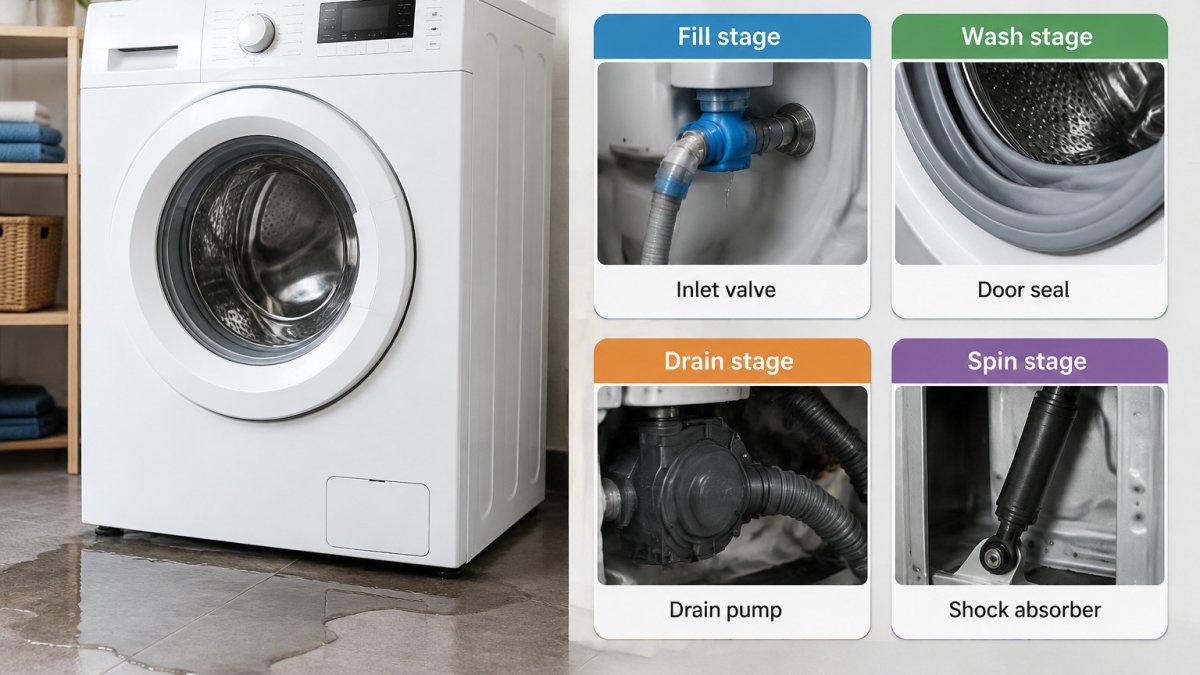
The fastest way to narrow it down is to match the leak to the stage of the cycle when it appears. Each stage pressurises a different part of the machine, so the timing tells you which subsystem to inspect.
Leak during filling (water inlet stage):
- Check the inlet hoses and the tap connections at the back.
- Inspect the inlet valve screen where the hose meets the machine, grit and scale can cause a poor seal.
- Look for drips from the detergent drawer if water is being flushed through it.
Leak during agitation or washing (drum full, no drain):
- On a front-loader, suspect the door gasket, especially along the bottom fold.
- On a top-loader, check the tub seal and the dispenser area.
- Confirm the machine is level; a tilted drum can push water past seals.
Leak during draining (pump running):
- Inspect the drain hose along its full length for splits, especially at bends and clamps.
- Check the pump filter housing and its O-ring.
- Look at the drain pump itself for cracks or a loose housing.
Leak during spinning (high-speed rotation):
- Overloading and an unbalanced load are the most common causes.
- A worn door seal or tub seal can be forced open by the pressure of spinning.
- A partially blocked drain filter can cause back-up that overflows during spin.
Leak only when the machine is off:
- This usually points to a supply-side fault: a dripping inlet tap, a perished hose washer, or a faulty inlet valve that is not closing fully.
Use this sequence to isolate the stage, then inspect only the parts that stage pressurises. If the leak appears at more than one stage, start with the earliest stage, fixing an inlet leak often removes the water that later looks like a drain leak.
Step-by-Step: Inspecting and Replacing a Washing Machine Hose
Hoses are one of the cheapest and easiest parts to replace, but inlet and drain hoses fail in different ways and are replaced differently.
Skill level: beginner for inlet hoses; beginner-to-intermediate for drain hoses. Tools: screwdriver, adjustable pliers, bucket, towels. Time: 20-40 minutes per hose.
What you will need:
- Replacement hose (check the correct length, diameter and fittings for your model, inlet hoses are usually ¾-inch BSP fittings, drain hoses vary by brand)
- Flat-head or Phillips screwdriver
- Bucket and towels
- Adjustable pliers
- Replacement rubber washers for inlet fittings
Steps for an inlet hose:
- Turn off the water and unplug the machine, as described above.
- Place the bucket under the hose connection to catch water.
- Loosen the hose nut at the tap and at the machine by hand, then use pliers only if it is stiff.
- Check the mesh filter screen inside the machine inlet, rinse out grit and scale.
- Check the rubber washer at each end. Replace it if it is cracked or flattened.
- Fit the new hose, tighten the connections by hand, then add a quarter turn with pliers.
- Turn the water back on and check each joint for drips.
- Run a short cycle and check again.
Steps for a drain hose:
- Switch off and unplug, then drain any water left in the drum.
- On a front-loader, the drain hose usually runs from the pump housing at the base to a standpipe or spigot; you may need to remove the back panel or lower access panel to reach the pump end.
- On a top-loader, the drain hose typically connects at the back of the cabinet and is easier to reach.
- Loosen the clamp at the pump end and pull the hose free, keeping a towel under it.
- Check the spigot or standpipe connection for blockages before fitting the new hose.
- Fit the new hose, secure both clamps, and check that the hose has no kinks and sits above the trap where required.
- Run a drain or spin cycle and check both ends for drips.
Expected result: The hose connections stay dry during the test cycle, and the machine drains without back-up.
Fit inlet hoses with a rubber washer at each joint. Hand-tightening plus a quarter turn is usually enough. Over-tightening can crack the plastic fitting.
Model differences to check before you start:
- Front-loaders often hide the drain pump and hose connection behind a lower access panel or the back panel; some brands require removing the top lid first.
- Top-loaders usually expose the drain hose at the rear, but the pump end may sit under the tub.
- Integrated or compact machines may use proprietary hose fittings, so match the part number rather than buying a universal hose.
Checking the Door Seal on Front-Load Machines
On front-load machines, the door seal is a common leak point. The rubber gasket wears, cracks or collects mould and hair over time. Inspect it by pulling the rubber back gently and looking for tears, hardened spots and debris in the folds.
Clean the seal with warm soapy water and a soft cloth. Check the folds carefully, since small items like coins and hair often get trapped there.
If the seal is torn, you will need a replacement. For example, Allfix Electrical stocks a Samsung WW85T754DBT and WW90DG5U34AE front-loader door gasket (Part # DC97-18852C) for $55.65.
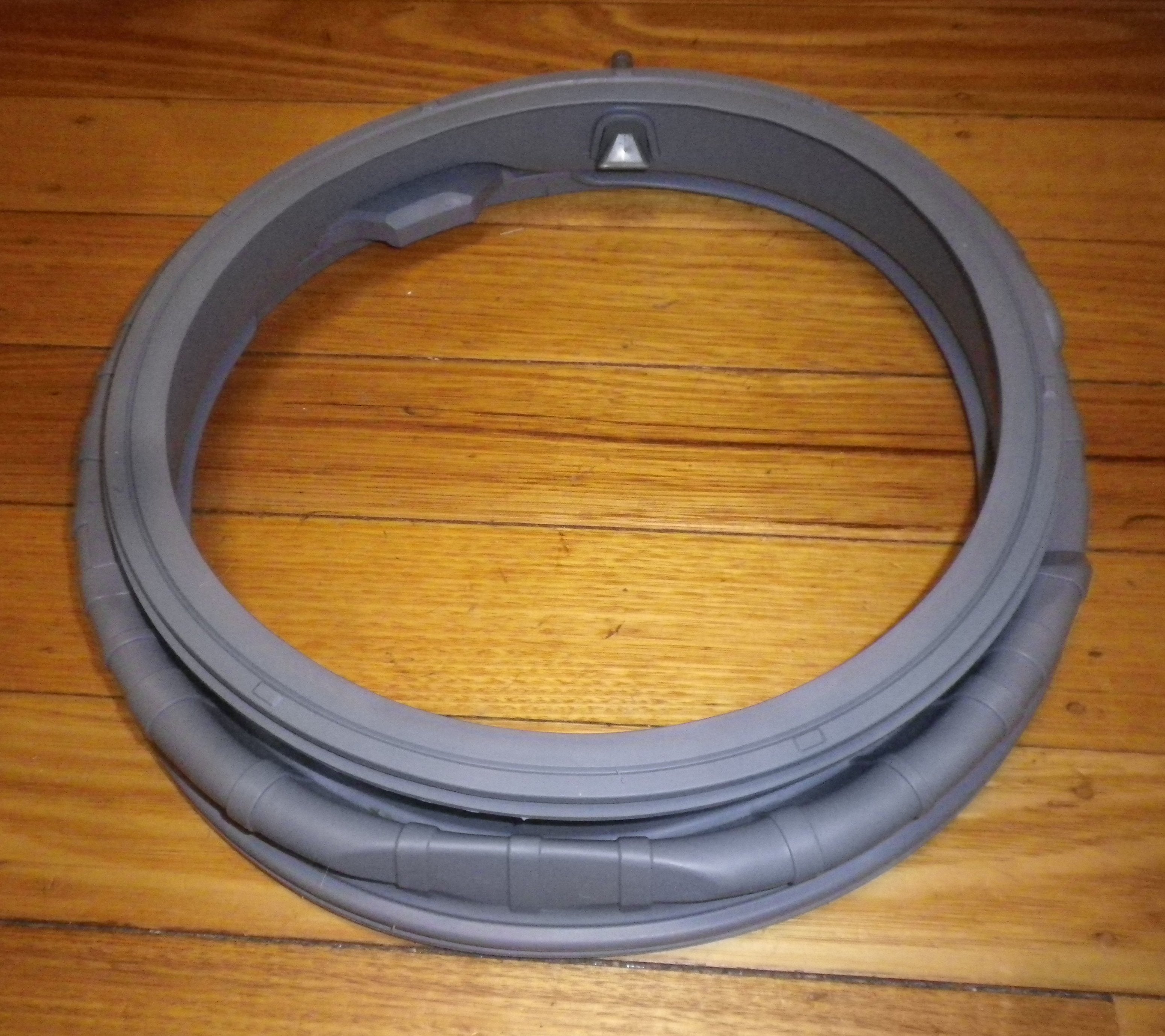
Fitting the new gasket takes patience. Work the rubber into the door frame slowly, starting at the top and moving around, so it sits evenly without twisting.
The article lists several replacement door gaskets and their prices, which can be compared at a glance:
| Gasket | Part # | Price |
|---|---|---|
| Samsung WW85T754DBT / WW90DG5U34AE front-loader | DC97-18852C | $55.65 |
| Bosch WGA254U00AU front-loader standard with tube | 20004575 | $146.74 |
| LG WD12020D washer with hole | 4986ER1005C | $94.58 |
Price
Why Your Washing Machine Leaks During the Spin Cycle
A leak during the spin cycle often has a simple cause. Overloading is a common reason a washing machine leaks during the spin cycle, because when the drum holds too much laundry, the machine can't spin evenly and water can be pushed out past the seals.
Check these points:
- Load size: Wash smaller loads and avoid cramming the drum.
- Level: Make sure the machine stands level. Adjust the feet until it does not rock.
- Vibration: A machine that walks across the floor can loosen hoses.
- Drain filter: A clogged filter can cause water to back up and overflow during spinning.
Clean the pump filter regularly. Place a towel under the filter, unscrew it slowly, and remove any debris. Water will come out, so have a tray ready.
Deciding Whether to Repair, Replace or Call a Technician
Many leaks cost little to fix. A hose or a gasket is usually cheaper than a new machine. However, some faults are harder to repair, and some machines are not worth fixing.
Consider a DIY repair when:
- The fault is a hose, clamp, filter or door seal
- You can match the part to your model
- The machine is relatively new
Call a technician when:
- The leak comes from inside the drum or from the tub itself
- The pump or electronics appear faulty
- You smell burning or see sparks
- You are unsure of the cause after basic checks
Compare the repair cost with the age and value of the machine. If the repair costs more than half the price of a new machine, replacement may be the better choice.
Watch out: Never run a leaking machine unattended. Water damage to floors and ceilings can cost far more than the repair itself.
With the right parts and a careful approach, most leaks are simple to fix. Start with the cheap checks, find the source, and replace only the part that has failed.
Frequently Asked Questions
Why is my washing machine leaking from the bottom?
Bottom leaks usually come from the drain pump filter, a cracked drain pump housing, a loose drain hose connection or a damaged inlet hose. Start by pulling the machine out from the wall and placing a towel or tray underneath. Check the pump filter first, since a blocked filter is the most common and cheapest cause to fix. If the water is clean and comes from the base of the cabinet, look at the hose clamps and the pump housing next. A leak that only appears during a wash cycle usually points to a hose or pump problem rather than the tub itself.
Can I use my washing machine if it is leaking?
It is best not to run the machine until you have found and stopped the leak. Water can seep into the floor, subfloor and nearby cabinetry, and it can damage electrical connections if it reaches power outlets or the motor. Turn off the power at the wall and the water supply tap before you inspect the machine. If the leak is from the door seal, you can run a short cycle with the door open to test a repair, but only with supervision. Replace damaged parts before returning the machine to regular use.
How do I fix a leaking washing machine hose?
Turn off the water supply and unplug the machine. Use a torch to find the exact point of the leak, which is often at a crimped fitting or where a clamp has loosened. Tighten a loose clamp with a screwdriver or pliers. If the rubber is cracked, bulging or stiff, replace the hose rather than patching it. Most inlet hoses are standard threaded fittings and can be swapped in under an hour with basic tools. Always check the hose connection at the tap and the machine for loose washers, since a worn washer is a frequent source of drips.
Why is my front-load washing machine leaking from the door?
On front-load machines the door gasket, also called the boot or seal, is the most common source of leaks. Over time the rubber can tear, harden, or collect lint, hair and detergent residue in the folds, which lets water escape during the wash and spin. Wipe the entire gasket and check the lower fold, where debris often hides. Look for cracks, tears or a flattened section. If the gasket is damaged, a replacement part matched to your model is required. Using too much detergent or overloading the drum can also push water past the seal.

Share this post
- 0 comment
- Tags: fix leaking washing machine, how to fix leaking washing machine, washing machine door seal leaking, washing machine hose leaking, washing machine leaking during spin cycle, washing machine leaking from bottom
0 comment