
How to Fix a Washing Machine Not Draining: 7 DIY Fixes
Posted by Editorial Team on
Table of Contents
- Safety First: Before You Start Troubleshooting
- 1. How to Clean a Washing Machine Filter to Clear a Blockage
- 2. Check the Drain Hose for Kinks, Blockages and Height Problems
- 3. Reset and Power Cycle the Machine
- 4. Check Cycle Settings and Load Balance
- 5. Washing Machine Error Codes and Drainage Problems
- 6. Washing Machine Drain Pump Replacement: When the Pump Is the Problem
- 7. Manual Water Removal and Preventative Maintenance
- Frequently Asked Questions
Last Updated: September 27, 2026
Safety First: Before You Start Troubleshooting
A washing machine not draining is one of the most common appliance faults, and in most cases it traces back to a blocked filter, a kinked hose, or a tired drain pump rather than a dead machine. Before you touch anything, pull the power plug and shut off the water supply.

Water and electricity are a dangerous combination, and a drum full of standing water is heavy.
- Unplug the machine from the wall socket. Do not rely on the power button alone.
- Turn off the cold water tap feeding the machine.
- Wait 10-15 minutes for any residual current in the control board to discharge.
- Have towels, a shallow tray, and a container ready to catch water.
- Wear enclosed shoes. Detergent residue makes wet floors slippery.
If you are unsure whether a fault is safe to tackle yourself, a qualified appliance technician can diagnose it quickly. For everyone else, the seven checks below cover the overwhelming majority of drainage problems, starting with the simplest.
1. How to Clean a Washing Machine Filter to Clear a Blockage
The drain filter is the first thing to check, and it is the cause of most drainage faults. It sits behind a small access panel at the bottom front of the machine, or under the agitator on some top loaders.
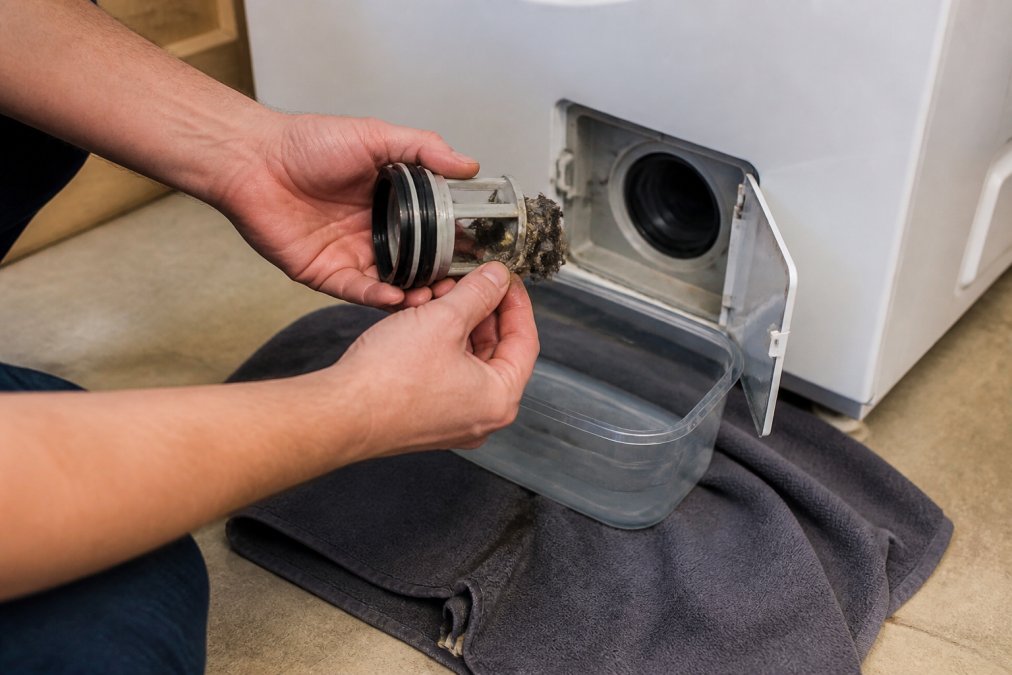
- Place a towel and shallow tray under the access panel.
- Unscrew the cap slowly. Water will trickle out, so let it drain into the tray.
- Pull the filter out and remove lint, coins, hair, and grit.
- Rinse it under warm water and check the housing for debris.
- Refit the filter and tighten the cap firmly.
2. Check the Drain Hose for Kinks, Blockages and Height Problems
The drain hose carries water from the pump to the standpipe or sink, and any restriction along that path will stall drainage. Pull the machine out and trace the hose from end to end.
3. Reset and Power Cycle the Machine
A power cycle clears a locked control board and takes two minutes. Modern machines run on electronic modules, and a momentary glitch can leave the drain cycle stuck.
4. Check Cycle Settings and Load Balance
- Soak and pre-wash cycles hold water between stages, so standing water mid-cycle is normal.
- Gentle, hand-wash and wool cycles often use a low final spin and a slow drain, which can look like a fault on a machine with a partially restricted filter.
- Delay-start and eco modes may sit with water in the drum for an extended period before the drain phase begins.
- Rinse-hold deliberately leaves the load sitting in water until you select the next stage.
One more check worth doing while you are here: confirm the machine is level. A machine that rocks on an uneven floor can trigger an out-of-balance cut-out during the drain and spin phase, and it will hold water until the load is redistributed. Adjust the feet until the machine sits flat and does not rock when you press down on opposite corners.
5. Washing Machine Error Codes and Drainage Problems
| Code | Typical brand family | What it means | First check |
|---|---|---|---|
| E1 / E01 | Many budget and house brands | Drain timeout, the machine did not empty within its set window | Filter, then hose |
| E2 / E02 | Many budget and house brands | Drain pump circuit fault or no pump signal | Pump terminals and wiring |
| F21 | Bosch, Siemens and related platforms | Drain fault, pump cannot clear the drum | Filter housing and impeller |
| E4 | LG and some Samsung models | Water inlet or drain imbalance depending on model year | Manual first, then filter |
| 5E / SE | Samsung | Water not draining | Hose height and filter |
| E20 | Electrolux, Westinghouse, Simpson | Drain system blocked or pump fault | Filter and pump |
| F9 / E9 | Fisher & Paykel | Drain or pump fault | Pump and pressure sensor |
| OE | LG | Drain timeout | Filter, hose, pump |
A few patterns hold across almost every brand:
Universal Magnetic Twist-On Pump Motor →

- A code that appears a set number of minutes into the cycle is usually a timeout, the board waited, the water level sensor never dropped, and it gave up. That points to a restriction, not a dead board.
- A code that appears immediately when the drain phase starts is usually a circuit fault, the board cannot see the pump at all. That points to the pump, its terminals, or the wiring harness.
- A code that clears on a power cycle but returns on the next load is intermittent, and intermittent drain faults are almost always a partially blocked filter or a worn pump impeller rather than a control board.
If the code points to a drain fault and the filter and hose are clear, move to the pump section below. If it points to a pressure or water-level sensor, the fault is in the sensing circuit rather than the drain path, and that is a job for a technician with a multimeter and the model's wiring diagram.
6. Washing Machine Drain Pump Replacement: When the Pump Is the Problem
Signs of a faulty drain pump include:
- A humming noise with no water movement.
- Rattling or grinding during the drain cycle.
- Intermittent draining that fails partway through.
- Water left standing after every cycle, not just occasionally.
Universal twist-on pump bodies suit many brands where the motor attaches to the cover with three retaining lugs. The Askoll universal pump motor at $42.86 fits a long list of front loaders, and the Plaset universal pump motor at $46.50 suits many LG, Samsung, and Whirlpool models. Always confirm the terminal type and voltage before fitting.

7. Manual Water Removal and Preventative Maintenance
Manual water removal gets the drum empty when the machine will not drain and you need the laundry out now. It is also the first step before any repair.
- Unplug the machine and lay towels around the base.
- Open the filter access panel and place a shallow tray underneath.
- Slowly unscrew the filter cap and let the water drain into the tray.
- Empty the tray into a bucket and repeat until the flow stops.
- For top loaders, bail the drum with a jug and sponge out the remainder.
| Task | Frequency | Why It Matters |
|---|---|---|
| Clean the drain filter | Every 3 months | Prevents lint and debris blockages |
| Inspect the drain hose | Every 6 months | Catches kinks and splits early |
| Check drain height | Once a year | Stops siphon and flow faults |
| Run a hot maintenance wash | Every 3 months | Clears detergent residue |
| Check pump for noise | Every 6 months | Catches a failing motor early |
Frequently Asked Questions
How can I force my washing machine to drain?
First, unplug the machine from the power point for safety. If the drain hose is accessible, lower it into a bucket placed below the machine to let water siphon out. Many front loaders have a small drain hose behind the filter cover that you can pull out and direct into a container. Once the water is removed, clean the filter and check the hose for kinks or blockages. If the machine still won't drain, the drain pump may need replacing.
How do I unblock a washing machine drain pump?
Unplug the machine, then locate the drain pump, usually behind the front kick panel or under the drum. Place towels and a shallow tray underneath. Remove the pump cover or filter housing and pull out any lint, coins, hair or debris trapped around the impeller. Check that the impeller spins freely by hand. If it is jammed, clear the obstruction. If the impeller is broken or the motor does not run when tested, replace the pump. Universal twist-on pump motors like the UNI200 ($50.14) fit many models.
How to get rid of standing water in a washing machine?
Unplug the machine first. For front loaders, open the filter access door at the bottom front, pull out the small emergency drain hose, and let water flow into a shallow bucket. For top loaders, bail water out with a cup or use a wet vacuum. Alternatively, lower the drain hose into a bucket below the water level to create a siphon. Once empty, clean the filter and check for blockages in the hose and pump.
Why does water stay in the bottom of the washing machine?
Water remains when the drain cycle cannot push it out. Common causes include a clogged filter, a kinked or blocked drain hose, a drain hose installed too high (above the standpipe limit), or a faulty drain pump. Error codes related to drainage often point to one of these. Start by cleaning the filter and checking the hose for kinks or obstructions. If those are clear, test the pump and replace it if it fails to run or is jammed.
Is it safe to open the drain filter while the machine is full of water?
No, opening the filter with water inside will cause a flood. Always unplug the machine and drain the water first. Use the emergency drain hose if your model has one, or lower the main drain hose into a bucket. Once the drum is empty, you can safely unscrew the filter. Keep towels and a shallow tray ready, as some residual water will still spill when you remove the filter.
Share this post
- 0 comment
- Tags: how to clean washing machine filter, how to fix washing machine not draining, washing machine drain pump replacement, washing machine error codes drainage, washing machine not draining
0 comment