Finding Discontinued Appliance Spare Parts: 2026 Guide
Posted by Editorial Team on
Table of Contents
- How to Find Discontinued Appliance Spare Parts
- Appliance Model Number Lookup: Where to Find It and What It Tells You
- Genuine Replacement vs Aftermarket vs Salvage Parts
- Universal Appliance Parts Compatibility: How to Cross-Reference Safely
- 3D Printing and Custom Fabrication for Obsolete Components
- When to Replace vs Repair Appliances With Discontinued Parts
- Warranty, Legal and Safety Considerations
- Conclusion
- Frequently Asked Questions
Last Updated: September 24, 2026
How to Find Discontinued Appliance Spare Parts
Finding discontinued appliance spare parts is rarely impossible. Confirm the exact model, trace the correct part number, then search beyond the first supplier who says "no longer available." At Allfix Electrical, we've spent over 40 years sourcing components for white goods, electronics and everything in between, and many "discontinued" parts are findable through the routes below.
Here's the sequence that works, in order:
- Find the model and serial number on the appliance data plate.
- Trace the part number from a schematic or exploded view diagram.
- Check stock availability with a parts supplier before ordering.
- If it's gone, cross-reference, salvage, or fabricate.
Start With the Model and Serial Number
Every search starts with the data plate, a sticker or metal tag, usually inside the door, on the back, or behind the kick panel.
Trace the Part Number and Check Stock Availability
Once you have the model, look up the part number for the failed component. Manufacturer schematics and exploded view diagrams show exactly which part sits where.
From there:
- Search the part number directly with a supplier.
- Ask about stock availability before you pay.
- Confirm the part is genuine replacement stock, not a generic substitute.
Appliance Model Number Lookup: Where to Find It and What It Tells You
An appliance model number lookup tells you exactly which variant of a machine you own, the key to matching the right component. Model numbers are not the same as the product name on the box.
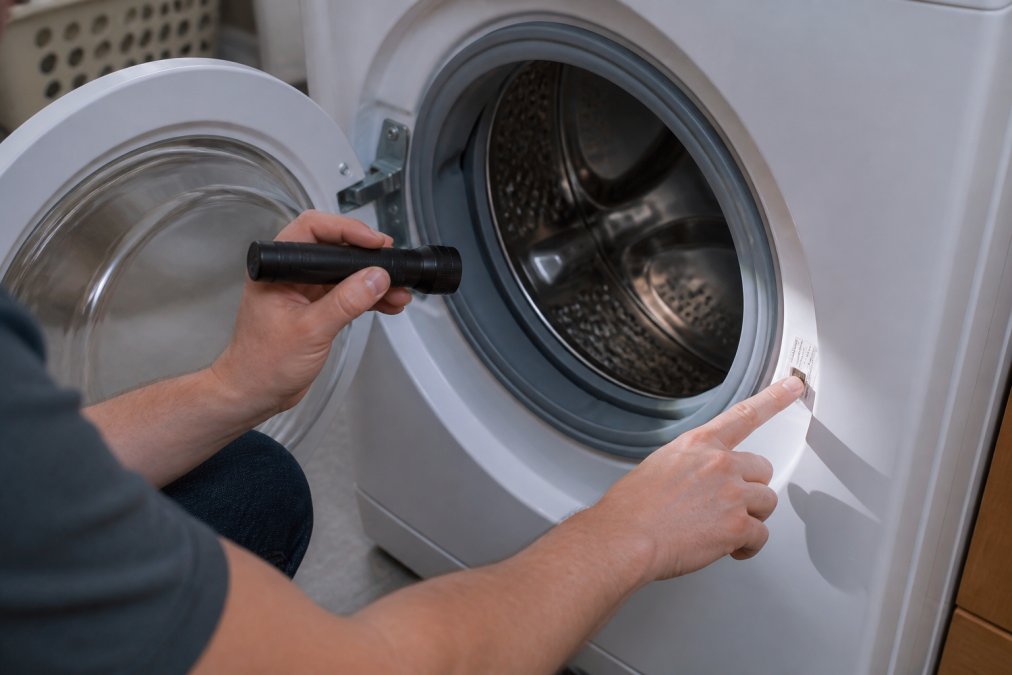
Where to look, by appliance:
Appliance |
Common data plate location |
|---|---|
Washing machine |
Inside the door rim or behind the detergent drawer |
Fridge or freezer |
Inside the fridge compartment or on the back panel |
Dishwasher |
On the side of the door or the inner frame |
Oven |
Behind the door, on the frame, or on the back |
Dryer |
Inside the door or on the rear panel |
Genuine Replacement vs Aftermarket vs Salvage Parts
Genuine replacement parts come from the original manufacturer and match exactly. Aftermarket parts are made by third parties to the same spec. Salvage parts are pulled from donor machines.
Each has a place:
- Genuine: best fit, usually highest cost, often the first to be discontinued.
- Aftermarket: cheaper and more available, but quality varies by maker.
- Salvage: ideal for obsolete parts, but you're relying on the donor unit's condition.
Universal Appliance Parts Compatibility: How to Cross-Reference Safely
Universal appliance parts compatibility means a component is built to fit a range of models rather than one. Cross-referencing matches a discontinued part to a universal or shared equivalent, the highest-yield technique here, because most "discontinued" parts are still in production under a different number.
The cross-reference method
Work through these in order. Stop as soon as you have a match you can verify.
- Record the original part number and its supersession chain. Many manufacturers publish a superseded-to list. If your number has been replaced, the replacement is usually still stocked.
- Match by function, not by name. A "door latch assembly" on one model is a "door interlock" on another. Search by what the part does and where it sits.
- Compare the physical envelope. Mounting hole spacing, shaft diameter and length, overall dimensions, and the orientation of any locating tabs. Measure the original with calipers rather than eyeballing it.
- Compare the electrical specification. Voltage, wattage or current draw, connector type and pin count, and terminal spacing. A part that fits mechanically but draws different current is not a match.
- Check the operating environment. Temperature rating, whether the part is in a wet zone, and whether it carries mains voltage. These determine whether a generic substitute is even permissible.
Where to find cross-reference data
- Manufacturer parts portals and supersession lists. Many publish these publicly even for older ranges.
- Exploded view diagrams for sibling models. If your model shares a platform with a later variant, the diagram for the later variant often shows the current part number for the same position.
- Specialist parts distributors. The good ones maintain their own cross-reference databases built from decades of matching. This is where a supplier's institutional knowledge genuinely earns its keep, not as a substitute for your own checks, but as a shortcut to candidates you then verify.
- Trade forums and repair communities. Useful for confirming that a known substitution works in practice, but treat any single claim as unverified until you check the specifications yourself.
What a safe cross-reference looks like
A substitution is safe when the part matches on function, physical fit, electrical rating and environmental rating, and a wrong match would fail benignly. It is unsafe when any of those four is uncertain, or when the part is safety-critical.
- Anything carrying mains voltage or forming part of an earthing path
- Gas valves, thermocouples and flame-sensing components
- Sealed refrigeration system components
- Thermal cut-outs, fuses and over-temperature protection
- Door interlocks on machines that spin or heat
3D Printing and Custom Fabrication for Obsolete Components
When a part is genuinely obsolete and no equivalent exists, one route remains: pull a used one from a donor machine.
Salvage and donor appliance sourcing
A donor machine is an appliance of the same model, or a close sibling, being sold or scrapped for parts. For obsolete components, this is often the fastest and cheapest route.
Where donor machines turn up:
- Online marketplaces, where listings are frequently tagged "for parts", "not working" or "spares only"
- Appliance repair businesses, which accumulate dead units and often sell components or whole carcasses
- Scrap metal yards and transfer stations, though access and removal policies vary by site and you should ask before assuming you can take anything
- Community noticeboards and social media groups, where a broken appliance is often given away for removal
How to source safely:
- Match the model, then the part number. A donor of the same model is ideal. A sibling model on the same platform is usually workable if the part number matches or supersedes.
- Ask why the donor failed. If it died of the same fault you are chasing, the part you want may be the failed component. If it died of something unrelated, the part you need is more likely to be sound.
- Inspect before you commit. Look for corrosion, heat discolouration, cracked housings, burnt connectors and water damage. A part that has been sitting in a damp yard for a year may be worse than the one you are replacing.
- Test where you can. For electrical components, a multimeter check for continuity and resistance against the expected value takes minutes and saves a second teardown.
- Harvest carefully. Photograph the assembly before you remove anything, keep fasteners with the part, and note the routing of any wiring or tubing.
When to Replace vs Repair Appliances With Discontinued Parts
Deciding when to replace vs repair appliances comes down to part cost, availability, and the age of the machine.
Repair makes sense when:
- The part is findable, even if it takes effort
- The appliance is otherwise in good condition
- The repair cost is a fraction of a replacement
Replace when:
- The part is truly unavailable and no workaround fits
- A second major component is also failing
- The appliance is near the end of its expected life
Warranty, Legal and Safety Considerations
Repairing an appliance can affect its warranty status. If the unit is still under a manufacturer's warranty, using non-genuine parts or a DIY repair may void it. Check the terms before you touch anything.
Conclusion
Hunting down a discontinued part is a test of patience and method. Get the model and serial number right, trace the part number, check live stock, then cross-reference or salvage.
Frequently Asked Questions
Where can I find parts for discontinued appliances?
Start by pulling the model and serial number off the rating plate, then search that number against an online catalog to confirm the exact part number. If the manufacturer has marked the component obsolete, look at aftermarket equivalents, cross-reference universal parts, or source a donor appliance of the same model. Specialist parts suppliers with deep inventory often hold discontinued stock that general retailers no longer list, so it pays to ask directly rather than assume a part is gone forever.
How do I identify the correct part number for an old appliance?
Use the model number from the rating plate, then locate the part on an exploded view diagram or schematic for that model. The diagram gives you the manufacturer's part number, which you can then cross-reference against aftermarket and universal listings. Photograph the failed component before removing it and note any numbers stamped on the part itself. If the numbers do not match, contact a supplier with your model and serial number for confirmation before ordering.
Are universal parts a safe alternative for discontinued components?
Universal parts can work well when the specification matches: same voltage, same dimensions, same mounting points and same ratings. They are common for items like heating elements, thermostats, belts and door seals. The risk is in the details, so check the part cross-reference and confirm compatibility with your model before buying. For safety-critical components or anything tied to the appliance's warranty status, a genuine or manufacturer-approved equivalent is the safer choice.
Can I use second-hand parts for appliance repairs?
Yes, donor appliances are a legitimate source for discontinued parts, particularly for mechanical components like motors, pumps and door assemblies. Check the donor's model number matches or is cross-compatible, inspect the part for wear and corrosion, and test it before installation. Avoid second-hand electrical components where insulation or contacts show damage. Salvage sourcing is often the only route when a part is officially obsolete and no aftermarket equivalent exists.
Share this post
- 0 comment
- Tags: appliance model number lookup, finding discontinued appliance spare parts, universal appliance parts compatibility, when to replace vs repair appliances
0 comment