
Why Appliance Parts Are Backordered and What to Do
Posted by Editorial Team on
Table of Contents
- Supply chain and manufacturing disruptions
- Backorder or Discontinued: How to Tell the Difference
- How Long Do Appliance Parts Take to Arrive?
- What to Do When an Appliance Part Is on Backorder
- Appliance Parts Alternatives and Compatibility
- How to Find the Correct Appliance Replacement Part
- Getting Your Appliance Running Again
- Frequently Asked Questions
What a Backordered Appliance Part Actually Means
A common part, like a door seal or a control board, can sell out faster than suppliers can restock.
Watch out: A backorder date is an estimate. Order confirmation does not guarantee the part will arrive on that date.
Want to see current availability? check our current stock and lead times before you commit to a long wait.
Why Appliance Parts Go on Backorder
Parts go on backorder for a handful of reasons, and understanding why appliance parts are backordered helps you judge how long the wait might last.
Supply chain and manufacturing disruptions
Manufacturing and shipping delays are a common cause. A factory shutdown, a shortage of electronic components, or a slow container shipment can hold up stock for weeks. Global supply chains are long, so one delay early in the chain can ripple through to local suppliers.
- Factory slowdowns or component shortages
- Delayed sea freight and port congestion
- Stock held up at customs
- Changes in the manufacturer's production schedule
High demand and limited inventory
Some parts sell far faster than distributors expect. A widely used fault, such as a faulty heating element or a common control board, can clear shelves in days. Suppliers often keep only a limited stock of each item, so a sudden spike in orders creates a backorder.
Backorder or Discontinued: How to Tell the Difference
This is the question that matters most. A backordered part will return to stock. A discontinued part will not. A third category, a shipping or picking delay, is neither, and treating it as a backorder can cost you weeks.
The five availability labels, decoded
Suppliers use these terms loosely, so read the listing wording carefully:
- In stock: The part is on the shelf and can be picked now. If it has not shipped within a couple of business days, ask whether it is a picking delay rather than assuming a backorder.
- Backordered: The seller has accepted your order but has no stock. The manufacturer or distributor has given a restock expectation. The part still exists and is still produced.
- Out of stock: Often used interchangeably with backorder, but sometimes means the seller has no supply line at all. Ask whether a restock date exists.
- Discontinued: The manufacturer has stopped making the part. The listing may say "discontinued by manufacturer" or "no longer available." Waiting will not help.
- Obsolete / NLA (no longer available): The part is not produced and is not held by the distributor. Your only routes are new old stock, a used part from a donor appliance, or a manufacturer-approved substitute.
How to verify a backorder properly
A listing label is not proof. Work through these checks before you commit money or a repair booking:
- Confirm the exact part number. Use the model and serial numbers on the appliance's rating plate, not just the brand and model name. A single model can use different parts across production revisions.
- Ask the supplier three specific questions. Is the part on backorder with the manufacturer or the distributor? What is the restock date, and is it a supplier-confirmed date or an estimate? If the date passes, what is the escalation path?
- Get the answer in writing. An email or order note with a date is easier to follow up than a phone conversation.
- Distinguish a true backorder from a delay. If the seller says the part is "in stock" but has not shipped, ask whether it is awaiting picking, a transfer between warehouses, or a freight delay. These resolve faster than a manufacturer backorder and should not be treated the same way.
- Check a second source. Stock levels differ between suppliers. A part backordered at one distributor may be on the shelf at another, especially for common components like door seals and heating elements.
Watch out: A restock date given at the point of order is an estimate, not a guarantee. Diarise the date and follow up in writing before you assume the part is lost or cancel a repair booking.
When waiting is not realistic
If the supplier cannot give a confirmed restock date, or the part is flagged as obsolete or NLA, stop waiting and move to alternatives. The decision framework below helps you weigh a long wait against repair or replacement.
How Long Do Appliance Parts Take to Arrive?
Wait times vary widely. A common backorder can last a few days to several weeks. Rare or older parts can take longer, and some never come back.
Many suppliers give an estimated arrival window once your order is placed. Treat that window as a guide, not a promise.
Repair timelines are also worth thinking about. For a rough sense of how long a typical appliance repair takes, read our guide on appliance repair timelines before deciding how long to wait.
Wait times vary, so the table below sets out the typical timing and what each situation means for your repair.
| Situation | Typical wait | What it means |
|---|---|---|
| Common backorder | A few days to several weeks | The part still exists and will restock |
| Rare or older part | Longer than a common backorder | Restock may take considerably longer |
| Discontinued part | No restock | Waiting will not help |
| Supplier estimate | A guide, not a promise | Get the date in writing and follow up |
What to Do When an Appliance Part Is on Backorder
Waiting is not your only option. Work through these steps:
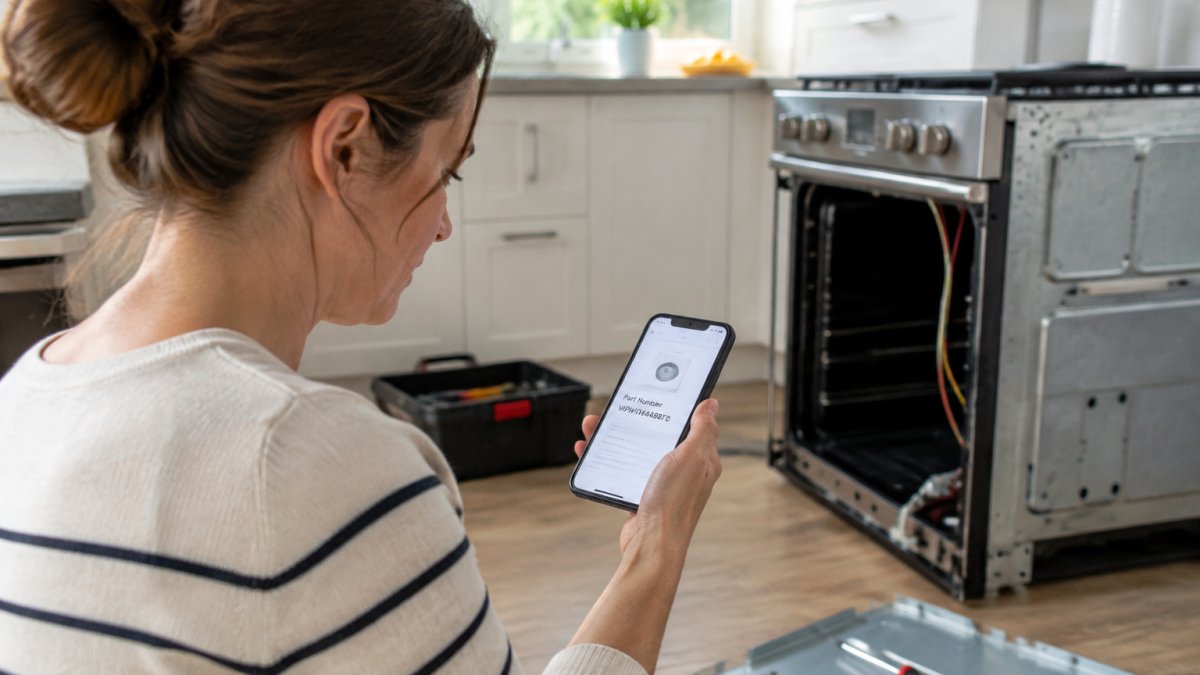
- Confirm the part number. Check the model number on your appliance's rating plate before you order again.
- Ask for an ETA in writing. Get a specific date or window from the seller.
- Check other sellers. Stock levels differ between suppliers, so a second source may have the part now.
- Ask about alternatives. Some sellers can suggest a compatible part.
- Decide whether to wait or replace. Use the framework below.
Repair or replace: a decision framework
Use these questions to decide:
- Is the appliance under warranty? If so, check whether the warranty covers the repair.
- How old is the appliance? Older units may not justify a costly part.
- What does the part cost compared with a replacement appliance?
- Is the appliance a safety risk, such as a fridge that is not holding temperature?
Cost matters too. A part that costs a fraction of a new appliance is usually worth waiting for. A part that costs more than half the price of a replacement may not be.
Watch out: Do not run a broken fridge or freezer for weeks while you wait. Move perishable food somewhere cold, or buy a temporary cooler, to avoid food spoilage.
Appliance Parts Alternatives and Compatibility
Sometimes a different part will work. Some sellers offer universal parts or manufacturer-approved substitutes. These can save time, but an incompatible substitute can damage the appliance or create a safety risk, so the checks below matter more than the saving.
A compatibility checklist before you fit a substitute
Work through every line. If any item cannot be confirmed, do not fit the part.
- Model and revision match. Confirm the substitute suits your exact model number and production revision, not just the brand. Manufacturers often change a component mid-production without changing the model name.
- Part number cross-reference. Ask the seller for the manufacturer's cross-reference showing the substitute replaces your original part number. A seller's own "fits" claim is not the same as a manufacturer cross-reference.
- Electrical specifications. Match voltage, wattage, current rating, and connector type. A control board or heating element with the wrong rating can fail immediately or overheat.
- Physical fit. Check dimensions, mounting points, terminal orientation, and clearances. A part that fits the housing but not the wiring loom is not compatible.
- Approvals and standards. For mains-powered components, confirm the part carries the relevant Australian electrical safety approval marking. Do not fit an unapproved mains component.
- Warranty position. Ask whether fitting a substitute affects the appliance's remaining warranty. Some manufacturers will not honour a claim where a non-genuine part has been fitted.
Universal versus genuine versus used
- Genuine part: Made or approved by the appliance manufacturer. Best fit and warranty position, but often the slowest to source during a backorder.
- Manufacturer-approved substitute: A superseded part number the manufacturer has designated as a replacement. Confirm the cross-reference in writing.
- Universal part: A generic component sold to fit many models. Useful for simple items like seals and belts, but risky for electronics and anything mains-powered.
- Used or donor part: Pulled from another appliance. Can be the only route for obsolete parts, but has no warranty and unknown service life. Inspect for corrosion, burn marks, and physical damage before fitting.
Watch out: Never improvise wiring, bypass a safety switch, or fit a part with a different electrical rating to "make it work." If the specifications do not match, the part is not compatible, regardless of what a listing claims.
When to stop and ask a technician
If the substitute involves mains wiring, a control board, a heating element, or a gas component, have a licensed technician confirm compatibility and fit it.
Are Universal Appliance Parts Worth It? A Practical Guide covers when a universal part makes sense and when it does not. Read it before you buy a substitute: see our practical guide to universal parts.
How to Find the Correct Appliance Replacement Part
The most common mistake is ordering the wrong part. Take these steps to avoid it:
- Find your model and serial numbers on the rating plate, usually inside the door or at the back.
- Remove the old part and note its markings.
- Compare the part number with the seller's listing.
- Photograph the old part from several angles and send the photos to the seller.
If a part looks like the one you need but the numbers do not match, do not order it. Ask a technician or the seller to check first.
Do you need a new part at all? Some problems have simple causes that a clean or reset will fix. Our checklist on signs a part really needs replacing can help you confirm before you buy.
Getting Your Appliance Running Again
A backorder is frustrating, but it is rarely the end of the road. Confirm the part number, get a written estimate, check other sellers, and weigh the cost of waiting against replacing the appliance.
If you need help identifying the right part or want a clear answer on stock and timing, contact Allfix Electrical. Contact Allfix Electrical to check the part number and ask about lead times before you commit.
Frequently Asked Questions
Why are appliance parts backordered?
Appliance parts are usually backordered because the supplier does not have enough stock to meet demand at that moment. Common causes include manufacturing or shipping disruptions that slow stock arriving from overseas, sudden spikes in demand after a product recall or a popular model release, and components that are electronic or model-specific and therefore produced in smaller batches. A part can also show as backordered while the supplier waits on a replenishment order. Checking the stated reason with the seller is the quickest way to get a realistic picture of when stock will return.
How long do backordered appliance parts usually take?
Backorder times vary widely, from a few days when stock is already on its way to several weeks or longer when a part is imported or in short supply. Lead times depend on the supplier, the part, and whether the item is still being produced. Estimates are not guarantees, so it is sensible to ask for a specific expected date and to check again if that date passes. For current lead times and delivery options on Allfix Electrical parts, please visit the Allfix Electrical website or request a quote directly.
Can I use an alternative part if the original is backordered?
Sometimes, but only after confirming compatibility. Match the part number, the appliance model number, and the key specifications such as voltage, dimensions, connector type, and rating. Do not fit a part that is only close in size or appearance, particularly electrical components such as control boards or relays, because a mismatch can damage the appliance or create a safety hazard. If you are unsure, ask a technician or the supplier to confirm the substitute before you install it.
How can I check whether an appliance part is compatible?
Start with the appliance's model and serial number, which are usually on a label inside the door or at the back of the unit. Use these to look up the exact part number rather than relying on the name of the component. Compare the old part with the replacement, paying attention to electrical ratings, mounting points, and connections. Where a part is still under warranty or the appliance is complex, having a qualified technician verify the fit is worth the time and cost.

Share this post
- 0 comment
- Tags: appliance parts alternatives and compatibility, how long do appliance parts take to arrive, how to find the correct appliance replacement part, what to do when an appliance part is on backorder, why appliance parts are backordered
0 comment