
Allfix Electrical Appliance Parts Warehouse: Parts Guide for Repairs
Posted by Editorial Team on
Table of Contents
- Why a Dedicated Appliance Parts Warehouse Beats Guesswork
- Common Whitegoods Parts You'll Find in Stock
- How to Identify the Correct Replacement Part
- Appliance Parts Inventory Management for Busy Workshops
- Inventory Management Software for Repair Shops: What to Look For
- How to Organise Spare Parts So You Stop Reordering Twice
- Repair or Replace? The Sustainability Question
- Conclusion
- Frequently Asked Questions
Last Updated: September 28, 2026
Why a Dedicated Appliance Parts Warehouse Beats Guesswork
An appliance parts warehouse is a stocked facility holding genuine and aftermarket components for whitegoods, ready to dispatch the moment a repair is confirmed. It removes the guesswork of ordering blind from a marketplace listing and hoping the part fits.
- Depth of stock across major and minor appliance categories, not just the fast-moving lines
- Technical expertise on hand to match a part to a model before it ships
- Fast dispatch, typically 1-5 business days from order to delivery
Common Whitegoods Parts You'll Find in Stock
A working spares warehouse carries the components that fail most often. Door seals perish, elements burn out, hoses split, and thermostats drift out of calibration. These are the parts that turn a dead appliance back into a working one.
Washing Machine Hose and Water Inlet Filter
The washing machine hose and water inlet filter are two of the cheapest parts to replace and two of the most common causes of a machine that won't fill or leaks mid-cycle. The inlet filter traps grit before it reaches the valve, and when it clogs, the machine either fills slowly or not at all.
Oven Elements, Thermostats and Door Seals
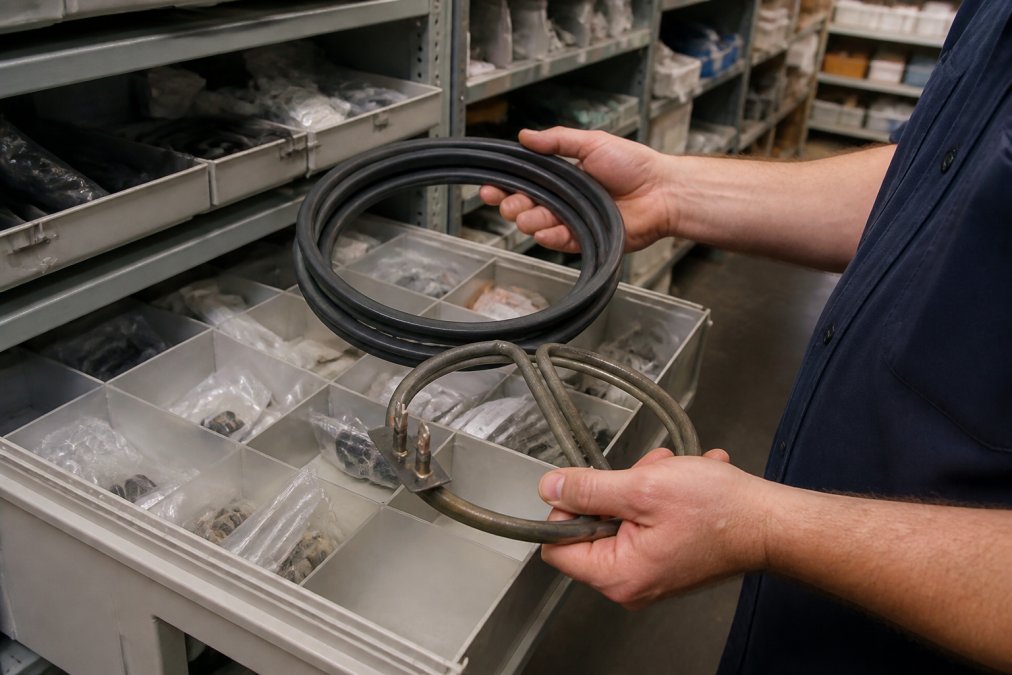
Oven faults usually trace back to one of three components. A fan-forced oven element stops heating when the coil breaks, and the oven runs cold or unevenly. A thermostat or temperature regulator loses accuracy over time, so the oven cooks hot or cool. A door seal hardens and lets heat escape, which forces the element to work harder and drives up running costs.

How to Identify the Correct Replacement Part
The single most reliable way to find the right part is to match it against your appliance's model number, not its appearance.
Here's the process that works:
- Pull the appliance out and locate the rating plate
- Photograph the plate so you have the model and serial number on hand
- Note the part number stamped on the old component if it's still readable
- Cross-reference the model number against the supplier's compatibility list
- Confirm wattage, voltage and dimensions before ordering
Reading the Model and Serial Number
The model number tells you exactly which variant you own. The serial number narrows it further, because manufacturers change internal components mid-production without changing the model name.
Appliance Parts Inventory Management for Busy Workshops
Appliance parts inventory management is the practice of tracking what you hold, what moves, and what needs reordering so you never lose a job to a missing component. For a busy workshop, it's the difference between a same-day fix and a two-week wait.
A practical approach for a small workshop:
- Record every part used against the job it went into
- Flag the components you reorder more than once a month as core stock
- Set a minimum quantity for each core part and reorder at that line
- Review slow-moving stock quarterly and reduce holdings
- Keep a compatibility note against each part so anyone can match it to a model
Inventory Management Software for Repair Shops: What to Look For
Inventory management software for repair shops should do one job well: tell you what you have, where it is, and when to reorder. Everything else is optional.
- Barcode or part-number search so a technician can find a component in seconds, not minutes
- Minimum stock alerts that trigger a reorder before you run out of a fast-moving line
- Job-linked usage tracking that ties a part to the repair it went into, so you can see which components fail most often
- Supplier and lead-time fields so you know how long a reorder takes before you promise a customer a date
- Compatibility notes attached to each part record, linking the part number to the models it fits
- Superseded part-number mapping, so a discontinued code still returns the current replacement
The Compatibility Field Is the One That Saves Jobs
Most generic inventory tools treat a part as a single SKU with a description. An appliance parts operation needs more. A fan-forced oven element might fit a dozen model variants across several brands, and the same physical element can carry three or four equivalent part numbers depending on which manufacturer's catalogue you're reading.

A workable record for an appliance part holds:
- The primary part number and any superseded or equivalent numbers
- The wattage, voltage and physical dimensions
- The appliance categories and model ranges it fits
- A photo of the part and its mounting points
- The supplier and typical lead time
What You Don't Need
A workshop with a few hundred active part numbers gets more value from a simple, well-maintained system than an elaborate one nobody updates.
How to Organise Spare Parts So You Stop Reordering Twice
Learning how to organise spare parts comes down to one principle: a part you can't find in ten seconds is a part you'll reorder by mistake.
Universal Oven Door Seal 4 Sides with →
A simple system that prevents double-ordering:
- Label every drawer and bin with the exact part number
- Group stock by appliance type, then by function
- Keep a running count updated at the point of use
- Mark the minimum stock level on the bin itself
- Store superseded part numbers alongside the current one
- Photograph each part in place for quick visual matching
Repair or Replace? The Sustainability Question
Repairing an appliance keeps it out of landfill and usually costs far less than a new unit. The question is whether the repair makes economic sense for the age and condition of the machine.
The Repair-Side Signals
A few things tip the balance toward repair:
- The appliance is otherwise sound
- The faulty part is inexpensive and accessible
- The repair is a single component, not a failing compressor or main control board
- The part is available from local stock, so the appliance is back in service within days
- The cabinet, drum or cavity is structurally sound with no rust or impact damage
The Replace-Side Signals
Replacement starts to make more sense when:
- A major sealed component fails
- Multiple systems are worn at once, so the repair bill approaches the cost of a new unit
- The appliance is already near the end of its working life and parts are discontinued
- The energy or water rating is poor enough that running costs outweigh the repair saving
- The cabinet or drum is corroded, cracked or otherwise compromised
A compressor or main board failure on an old unit often costs more than the machine is worth.
The Sustainability Case
Every appliance kept in service is one fewer unit manufactured, shipped and eventually discarded. Manufacturing a new appliance carries a significant embodied energy and materials cost. Repair also avoids the transport and processing emissions of disposal. Extending the lifespan of your machine requires recognizing the subtle professional repair signs that indicate when a component failure has moved beyond a simple DIY fix.
A Practical Test
Before you decide, ask three questions:
- What is the total cost of the repair, including the part and any labour?
- How old is the appliance, and what is its expected remaining service life?
- Is the part available now, or will the wait leave the household without a working appliance for weeks?
If the repair cost is a small fraction of a replacement and the appliance has years left, repair wins on both money and materials. If the repair cost approaches replacement and the unit is near end of life, replacement is the rational call.
Conclusion
The guesswork in appliance repair almost always comes from ordering the wrong part or waiting weeks for it to arrive. A stocked spares warehouse removes both problems by keeping common components on the shelf and matching them to your model before dispatch.
Frequently Asked Questions
How do I identify the correct replacement part for my appliance?
Find the model and serial plate, usually inside the door, on the back panel or behind the kickplate. Note the full model code, then match it against the compatibility list on the product page. For example, the Simpson Eziset reversing dryer drum belt lists models such as EDV605 and SDV501, plus the belt size of 1930mm circumference and 11mm width. If the plate is worn, photograph it and send the image to the supplier for confirmation before ordering.
How do I organise a spare parts warehouse so I stop double-ordering?
Group stock by appliance type first, then by component family: door seals, oven elements, thermostats, sensors, fan motors and belts. Label every bin with the part number and the models it suits, not just a description. Keep a running list of what you use weekly so reorder points reflect real consumption. A simple rule of two prevents both stockouts and dead stock piling up in the back corner.
Are appliance spares cheaper than replacing the whole unit?
Usually yes, by a wide margin. A universal oven door seal costs $46.50 and a Westinghouse fan forced oven element is $40.31, while a new oven runs into the hundreds. Repair also keeps a working appliance out of landfill, which matters given how much embedded energy sits in a fridge or washing machine. The exception is a sealed compressor failure or a rusted-out drum, where labour and parts together approach replacement cost.
How fast can an appliance spares warehouse dispatch my order?
Handling time is typically 1 to 5 business days, with delivery tracking supplied once the parcel leaves. Ordering from a local warehouse rather than an overseas seller cuts weeks off the wait, which matters when a fridge or washing machine is out of action. If you need a part same-day, check whether the supplier runs a physical trade counter you can visit in person.
Share this post
- 0 comment
- Tags: appliance parts inventory management, appliance spares, appliance spares warehouse, how to organise spare parts, inventory management software for repair shops
0 comment