
What Are the 10 Most Common Washing Machine Problems?
Posted by Editorial Team on
Last Updated: October 26, 2026
Quick Summary
The most common washing machine problems are power and start faults, drainage clogs, spin failures, fill faults, leaks, unusual noise and shaking, and mid-cycle stops or locked doors. Most trace back to simple causes like blocked filters, kinked hoses, unbalanced loads or closed taps. Check power, taps, filters and the door latch before buying any parts.
- Unplug the washer and turn off the water taps before touching anything inside the machine.
- A washer that will not start is usually a power supply problem, not a dead machine.
- A washing machine not draining is almost always a blocked filter, kinked hose or failed pump.
- A split front loader door gasket leaks during the wash and leaves a puddle at the front.
- Note the error code on the display before troubleshooting a washer that stops mid-cycle.
Table of Contents
- Safety First: Before You Troubleshoot Any Washing Machine
- 1. Washer Will Not Turn On or Start
- 2. Washing Machine Not Draining: Drainage Faults and Clogs
- 3. Washing Machine Not Spinning: Spin Cycle Failures
- 4. Washer Will Not Fill With Water
- 5. Washing Machine Leaking Water: Finding the Source
- 6. Unusual Noises, Shaking and Excessive Movement
- 7. Washer Stops Mid-Cycle or Door Will Not Unlock
- Frequently Asked Questions
Safety First: Before You Troubleshoot Any Washing Machine
Unplug the washer before you touch anything inside it. That single step prevents most serious injuries, and it is the one rule worth repeating: water and 240V mains power do not mix.
At Allfix Electrical, we have supplied appliance parts for over 40 years.
Before you start, run through this checklist:
- Switch off and unplug the machine at the wall
- Turn off the water taps feeding the inlet hoses
- Move any standing water with a towel or wet vacuum, not a household extension lead
Watch out: if the machine has been leaking near the power point or the cord is damaged, stop there. That is an electrician's job, not a parts swap.
Two differences matter before you begin. Front loaders hide their filter behind a small access panel at the bottom front, while top loaders usually have the pump and hoses behind a rear panel. Front loaders also lock the door electronically, so a mid-cycle stop and a door that will not unlock are often the same fault.
1. Washer Will Not Turn On or Start
A washer that will not start is usually a power supply problem, not a dead machine. Check the power point, the plug, the fuse in the plug and the circuit breaker before you suspect the control panel.
Work through it in this order:
- Test the power point with a lamp or phone charger.
- Inspect the plug for scorching or a loose cord.
- Reset the circuit breaker if it has tripped.
- Check the door is fully latched, since most machines will not start with an open door.
If the machine has power but the control panel stays dark, the fault sits in the board or the door switch. A common mistake is buying a control board before checking the door interlock, which fails far more often and costs far less.
2. Washing Machine Not Draining: Drainage Faults and Clogs
A washing machine not draining is almost always a blocked filter, a kinked drain hose or a failed drain pump. Nine times out of ten, the water is sitting there because lint, coins or hair have choked the path out.
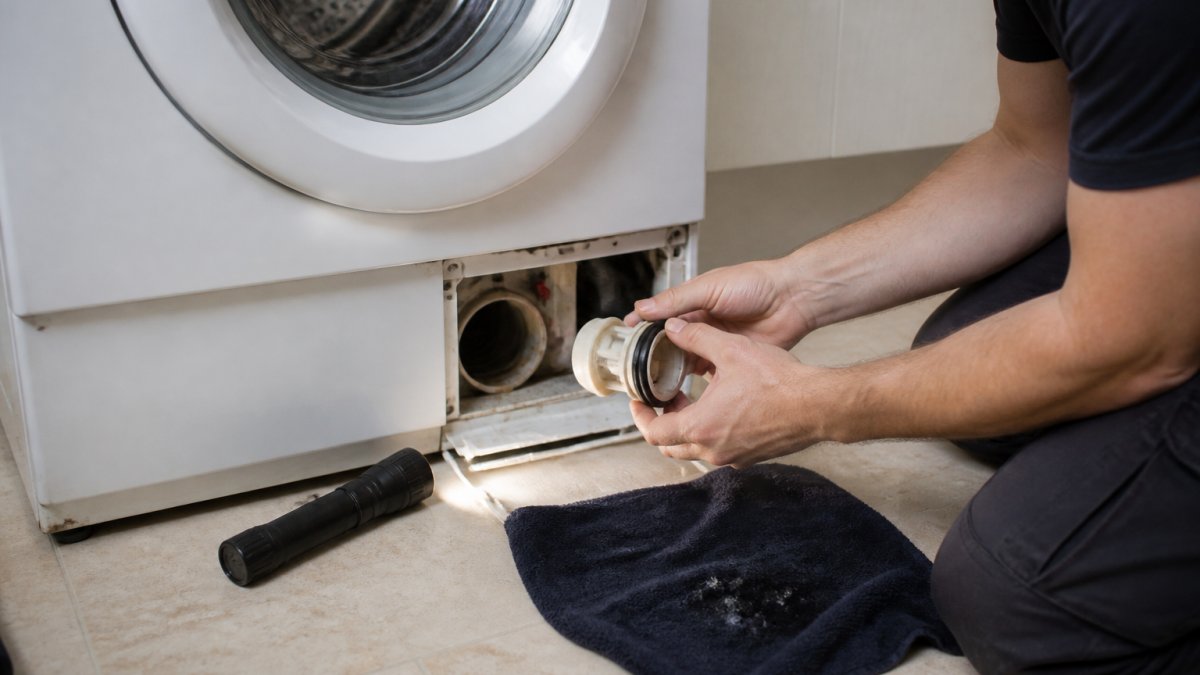
For a deeper walkthrough of this exact symptom, our guide on how to fix a washing machine not draining covers seven DIY fixes step by step.
When the Drain Pump Needs Replacing
If the filter and hose are clear but the pump hums or stays silent, the pump has failed. Match the part number to your model before ordering, because mounting holes and inlet angles vary between brands.
We stock pumps to suit a wide spread of machines, including a Maytag-compatible plastic drain pump at $73.31 and an LG-compatible drain pump motor at $81.64.
3. Washing Machine Not Spinning: Spin Cycle Failures
A washing machine not spinning usually points to an unbalanced load, a worn drive belt or a faulty lid or door switch. Modern machines refuse to spin when they sense an uneven load, so the fix is often simpler than you expect.
Try these first:
- Redistribute the load and run a spin-only cycle
- Check the machine is level on all four feet
- Confirm the lid or door is closing fully
If the drum turns freely by hand but never spins under power, suspect the belt or the motor coupling. If the drum will not turn at all, the fault is mechanical and needs a technician.
4. Washer Will Not Fill With Water
A washer that will not fill is a water supply problem before it is a machine problem. Work from the tap to the drum, because the fault is usually upstream of the inlet valve.
Check the Supply Side First
Start at the wall. Confirm both hot and cold taps are fully open, quarter-turn taps are easy to leave half-closed, and a single closed tap will stop a fill cycle on a machine that expects both.
Check the inlet hoses for kinks, crushing behind the machine, or a perished inner lining that has collapsed. A hose that looks fine outside can be blocked inside.
New Type Maytag Plastic Drain Pump - Part No. 1030227WS, 21001906, LP123 →
Model-Type Differences
Front loaders typically use two inlet valves (hot and cold) and a pressure switch or flow meter to sense water level. If only one valve has failed, the machine may fill slowly or take in water at the wrong temperature. Top loaders often use a single valve and a pressure tube; a disconnected or split pressure tube will make the machine think the tub is already full, so it never opens the valve.
Test the Inlet Valve
If water reaches the machine but nothing enters the drum, the inlet valve has likely failed. A common mistake is replacing the valve when the real fault is a blocked filter screen behind the hose connection, so clean that first.
When the valve is genuinely at fault, a replacement is a straightforward fix. Our universal dual inlet valve for older machines suits a range of older models, and we also carry a reconditioned Samsung 5-way inlet valve at $90.00 for compatible top loaders.

Repair or Replace?
A failed inlet valve is one of the cheaper washing machine problems to fix, so it rarely justifies replacing the machine on its own. If the valve is the only fault and the machine is otherwise sound, replace the valve. If the valve has failed alongside board faults, repeated error codes, or a leaking drum, weigh the repair cost against the age of the machine, most practitioners treat a repair costing more than half the price of a comparable new machine on a unit over eight years old as a signal to replace rather than repair.
5. Washing Machine Leaking Water: Finding the Source
A washing machine leaking water almost always traces back to a loose hose connection, a worn door seal or an overloaded detergent drawer. Find the source before you buy anything.
Check these in order:
- Tighten the inlet hose connections at both ends
- Inspect the door gasket for splits, mould or trapped debris
- Clean the detergent drawer and its housing
On a front loader, a split door gasket will leak during the wash and leave a puddle at the front. We stock a Samsung front loader door gasket at $55.65 for listed models.

6. Unusual Noises, Shaking and Excessive Movement
Excessive shaking and unusual noises usually mean an unbalanced load, worn suspension rods or a foreign object trapped in the drum. Sort the load first, then look at the hardware.
Listen for the pattern:
- A banging thud on spin points to an unbalanced load or worn suspension
- A metallic rattle suggests coins or bra wires in the drum
- A grinding noise often means worn drum bearings
Top loaders with worn suspension rods bounce heavily even with a light load. A replacement kit is a practical fix: our Westinghouse suspension rod kit, set of four, costs $93.83 and suits listed late-model machines.

Scale build-up in hard water areas also shortens appliance life and reduces efficiency. A heavy duty home descaler at $18.60 removes calcium and lime from internal parts as part of a regular maintenance routine.
7. Washer Stops Mid-Cycle or Door Will Not Unlock
A washer that stops mid-cycle or refuses to unlock its door is usually reacting to a fault code, an unbalanced load or a failed door interlock.
Most machines pause when they cannot balance the load or drain properly, so clear the filter and redistribute the wash first.
When the door will not unlock after the cycle ends, the interlock switch has often failed.
Here is a quick summary of what we have covered:
| Problem | Most Likely Cause | First Fix | Part If Needed |
|---|---|---|---|
| Will not start | Power supply or door switch | Test power point, check door | Door interlock |
| Not draining | Blocked filter or failed pump | Clean filter, check hose | Drain pump |
| Not spinning | Unbalanced load or worn belt | Redistribute, level machine | Drive belt |
| Not filling | Closed tap or failed inlet valve | Check taps and filters | Inlet valve |
| Leaking | Hose connection or door seal | Tighten hoses, inspect gasket | Door gasket |
| Shaking or noise | Unbalanced load or suspension | Sort load, check rods | Suspension rods |
| Stops mid-cycle | Error code or door interlock | Read code, clear filter | Interlock switch |
Frequently Asked Questions
What are the most common washing machine problems?
The most frequent faults are a washer that will not drain, will not spin, will not fill with water, leaks, shakes or makes noise, stops mid-cycle, and shows electrical faults such as a tripped breaker or error code. Most of these trace back to a clogged filter, kinked hose, unbalanced load, worn pump or faulty inlet valve, and many can be diagnosed at home before you book a repairer.
Why is my washing machine not draining or spinning?
A washing machine not draining and not spinning usually share one cause: the pump cannot clear the water, so the control board blocks the spin cycle. Check the drain hose for kinks, clean the pump filter of lint and debris, and confirm the standpipe or sink outlet is clear. If the pump hums but does not move water, the drain pump motor is likely worn and needs replacing.
Why is my washing machine leaking water?
Leaks most often come from a loose or split inlet hose, a worn door gasket on a front loader, a blocked drain hose that overflows, or a failed pump seal. Dry the machine, run a short cycle and watch where the water appears. A door gasket leaking at the front points to the seal, while water underneath usually means the pump or internal hose.
How do I troubleshoot washing machine electrical faults safely?
Switch off the machine at the wall and pull the plug before any inspection. Check whether the circuit breaker or fuse has tripped, test the power outlet with another appliance, and look for a scorched cord or plug. If the breaker trips again as soon as the washer starts, stop and call a licensed technician, because the fault may be in the heating element or wiring.
When should I call a washing machine repairer?
Call a repairer when the fault involves mains wiring, a tripping breaker, a failed motor or a sealed drum, or when the repair cost approaches half the price of a new machine. Simple jobs such as cleaning a filter, replacing a drain hose, fitting a door gasket or swapping a suspension rod kit are within reach for a confident DIY repair.
If you have worked through these checks and the machine still will not behave, the fault usually comes down to one specific part rather than the whole appliance. That is where we can help. Allfix Electrical carries an extensive inventory of washing machine parts, offers expert technical assistance to confirm the right component for your model, and handles orders quickly, typically within 1-5 business days. Search our range today and get the correct part the first time.

Share this post
- 0 comment
- Tags: 10 common washing machine problems and solutions, washing machine electrical faults, washing machine leaking water, washing machine not draining, washing machine not spinning, washing machine problems
0 comment