
Is DIY Appliance Repair Worth It? A 2026 Guide
Posted by Editorial Team on
Table of Contents
- The Real Cost of DIY Appliance Repair vs Hiring a Pro
- Troubleshooting Washing Machine Electrical Faults: A DIY Reality Check
- Essential Tools for Home Appliance Repair
- Appliance Repair Safety Regulations and Legal Limits for DIY Work
- Warranty, Insurance, and Liability: What DIY Repairs Really Cost You
- A Decision Framework: When DIY Appliance Repair Makes Sense
- Conclusion: Weighing the Real Value of DIY Appliance Repair
- Frequently Asked Questions
Last Updated: October 4, 2026
The Real Cost of DIY Appliance Repair vs Hiring a Pro
Is DIY appliance repair worth it? For straightforward faults, yes. For anything involving mains wiring, sealed refrigeration systems or a still-warrantied machine, no. The honest answer depends on three things: the fault, your skill level, and what the part actually costs.
At Allfix Electrical, we have supplied appliance components to the trade and retail for over 45 years. A customer buys a $47.36 tool kit and a replacement heating element, fixes the machine in an afternoon, and saves a service call.
That gap between the two outcomes comes down to diagnosis, not effort.
The decision framework we use with customers is simple:
Situation |
DIY verdict |
Why |
|---|---|---|
Faulty door latch, seal or hose |
Worth it |
Low voltage, cheap part, visible fault |
Worn belt or blocked drain pump |
Worth it |
Mechanical, accessible, reversible |
Blown thermal fuse or heating element |
Usually worth it |
Modular part, clear symptom |
Circuit board or control panel fault |
Call a technician |
Misdiagnosis is expensive |
Any fault under manufacturer warranty |
Call a technician |
DIY voids the warranty |
Sealed refrigeration or gas system |
Call a technician |
Legally restricted work |
Troubleshooting Washing Machine Electrical Faults: A DIY Reality Check
Troubleshooting washing machine electrical faults is where most DIY attempts go wrong, because the visible symptom rarely matches the failed component.
Start with the user manual and the error code, fault code tables narrow the diagnostic path faster than any forum thread. If the machine shows no code, check the power outlet and cord before opening anything.
A multimeter separates diagnosis from guesswork: you can test a thermal fuse, heating element or door switch for continuity in under a minute. Without one, you are replacing parts on hope.
If you cannot trace the fault to a specific component with a meter, stop. That is the point where a service call costs less than the parts you would otherwise buy and may not be able to return.
Essential Tools for Home Appliance Repair
A basic home appliance repair kit is smaller and cheaper than most people expect: insulated screwdrivers, a multimeter, prying tools for plastic panels, and a rechargeable driver for back-panel screws.
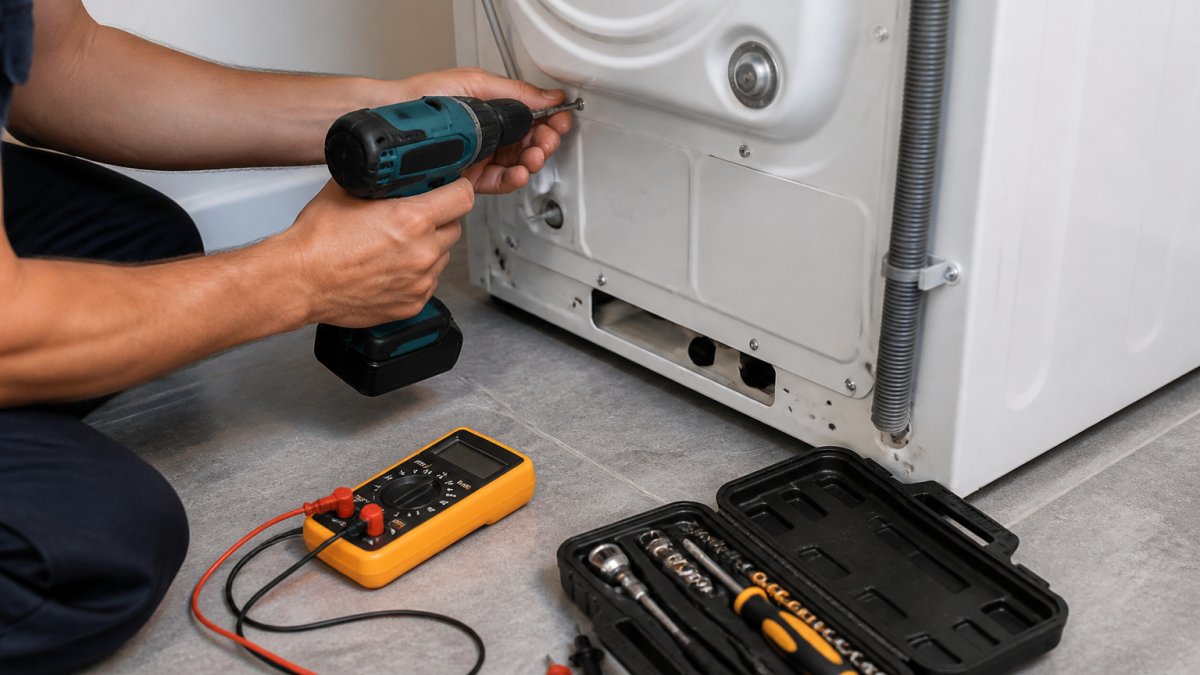
We stock the tools that customers ask for most often:
- T-Sprotek Cordless Electric Screwdriver & 3x Dual Bits (Part # STD6735) at $125.74. It delivers 10Nm of torque, up to 280RPM, and includes three dual-end PH2 and 5.5mm slotted bits in 65mm, 110mm and 150mm lengths. A built-in LED light helps in the dark cavity behind a machine. Note that it needs a USB charger, which is not included.
- GoldTool Cordless Electric Screwdriver with 55 Bits (Part # GTT151) at $141.41. This pen-style driver suits control panels, laptops and smaller electronics. It carries 55 bits across Phillips, hex, slotted, Torx, tri-wing, pentalobe and square profiles, plus a magnetiser and demagnetiser. Torque is 0.35Nm, so it is for precision work, not stubborn chassis bolts.
- T-Sprotek Essential Consumer Electronics Tool Set (Part # STE-502) at $47.36. A 42-piece kit with 30 assorted bits, prying tools, tweezers, a suction pad opener and a spudger. This is the entry point if you are opening a control panel for the first time.
- Pro'sKit 4 Piece Case Opener Tool Set (Part # MS-3176) at $28.95. Three nylon, heat-resistant pry tools and one metal spudger. These open plastic housings without cracking the clips, which is the most common damage we see from DIY panel removal.
The screwdriver in your kitchen drawer will strip a Phillips head on a washing machine chassis. A $28.95 pry set prevents a $200 panel replacement.

Appliance Repair Safety Regulations and Legal Limits for DIY Work
Appliance repair safety regulations draw a hard line between what a homeowner can legally do and what requires a licensed electrician. In Australia, fixed electrical wiring, switchboard work and any repair to a hard-wired appliance must be carried out by a licensed electrician, as set out in the Electrical Safety Regulations guidance.
For a plug-in appliance, the rules are less restrictive but the risks are real. You can replace a modular part. You cannot safely bypass a safety interlock, remove an earth connection, or repair damaged insulation on a power lead. Rules for plug-in appliances also can vary from one State to another so check what is legal before attempting any repair on a mains powered appliance.
Refrigerant handling is a separate restriction. Work on sealed refrigeration systems, including regassing a fridge or air conditioner, is regulated because of the gases involved, and the Australian Refrigeration Council licensing requirements set out who may legally do it.
Warranty, Insurance, and Liability: What DIY Repairs Really Cost You
A DIY repair can void your manufacturer warranty, the cost most people never factor in. If a machine is still inside its warranty period, any repair you perform yourself gives the manufacturer grounds to refuse a later claim, even if the fault is unrelated.
The ACCC guidance on consumer guarantees explains what you are entitled to when a product fails, and how a repair by an unauthorised party can affect that entitlement. Read it before you pick up a screwdriver on a new appliance.
How home insurance actually treats a DIY repair
Insurance is the second hidden cost, and the one most guides skip. The key distinction is between accidental damage and faulty workmanship: most home building and contents policies cover the first and exclude the second.
The practical consequence is a disclosure duty: when you lodge a claim, you are generally required to tell the insurer what happened, including that you carried out the repair. Withholding that detail is the fastest way to have the claim denied outright.
T-Sprotek Cordless Electric Screwdriver & 3x Dual Bits →
Liability beyond your own property
If you repair an appliance for someone else, a rental property, a neighbour's machine, a workplace, the liability picture changes. In a rental, repairs to fixed appliances are generally the landlord's responsibility, and a tenant who attempts one may be held liable for resulting damage. In a workplace, work on electrical equipment may fall under work health and safety duties requiring a competent person.
The safe rule is simple: if the appliance is not yours, or the repair touches fixed wiring, gas or refrigerant, do not DIY it. The cost of a licensed technician is the cheapest part of that decision.
The warranty-versus-saving trade-off
Put the two risks side by side. On a machine still under warranty, a DIY repair risks the entire remaining warranty for the sake of one service call. On an out-of-warranty machine with a modular fault, the warranty risk is zero and the insurance risk is low, because the repair is reversible and testable.
That is why the warranty question comes first in any decision framework: it is the single factor that most often flips the answer from 'worth it' to 'call a technician'.
A Decision Framework: When DIY Appliance Repair Makes Sense
DIY appliance repair makes sense when the fault is diagnosed, the part is modular, and the appliance is out of warranty.
Step 1: Is it under warranty? If yes, stop. Call the manufacturer or an authorised service provider.
Step 4: Does the part cost less than a third of a replacement appliance? This is the threshold most repair technicians use as a rough guide.
Step 5: Does the repair need a licensed trade? Fixed wiring, refrigerant handling and anything you cannot fully isolate and test are out of scope.
The repair-vs-replace calculation, worked through
A common pattern is to compare three numbers: the cost of the part, the cost of a service call, and the cost of a comparable new appliance.
Scenario |
Part cost |
Service call |
New appliance |
Verdict |
|---|---|---|---|---|
Washing machine drain pump, out of warranty |
Low |
Moderate |
High |
DIY if you can confirm the pump is the fault |
Fridge compressor or sealed system fault |
High |
High |
High |
Replace, the repair rarely justifies the cost |
Oven heating element, out of warranty |
Low |
Moderate |
High |
DIY, modular, visible, reversible |
Control board fault on a mid-range machine |
High |
Moderate |
Moderate |
Weigh carefully, misdiagnosis is the real cost |
Notice that the part cost alone does not decide it, the deciding factor is usually whether you can confirm the diagnosis before you buy. A $60 part that turns out to be wrong is a $60 loss plus the correct part plus the time. A service call that diagnoses and fixes the fault in one visit can be cheaper than two DIY attempts.
How do I know if my appliance is still under warranty?
Check the purchase date and the manufacturer's stated warranty period on the original documentation. Most major appliances carry a manufacturer warranty of at least two years, and consumer guarantees can extend beyond that depending on the product and the failure. If unsure, contact the manufacturer before opening the appliance.
When is an appliance beyond repair?
An appliance is usually beyond economic repair when the quoted repair cost approaches half the price of a comparable new unit, when the fault is in a sealed system, or when the cabinet, drum or chassis is structurally compromised. At that point, repair stops being a saving and starts being a sunk cost.
Conclusion: Weighing the Real Value of DIY Appliance Repair
The value of a DIY repair comes down to diagnosis. Fix a fault you have correctly identified, with a part costing a fraction of a new machine, and you save real money. Guess at the fault and you buy parts you cannot use.
If you are sourcing a replacement component, Allfix Electrical supplies parts for major white goods, minor appliances and electronics, with fast handling on orders and technical help to match the right part to your model.
Search our range to find the part you need, or ask us before you buy.
Frequently Asked Questions
What are the safety risks of DIY appliance repair?
The main risks are electric shock from live components, burns from heating elements, and water damage from incorrect reassembly. Appliances like washing machines and fridges store residual charge even when unplugged. Without a multimeter and proper isolation, you risk serious injury. Australian safety regulations require licensed electricians for any work on fixed wiring or mains-connected components, so stick to unplugging, visual inspection, and part replacement only.
How do I know if my appliance is worth repairing?
Use the 50% rule: if the repair cost exceeds half the price of a new appliance, replacement usually wins. Also factor in age. A fridge under 7 years old with a faulty thermal fuse is often worth fixing. A 12-year-old washing machine with a failed circuit board is not. Check parts availability first, because a cheap repair becomes pointless if the component takes weeks to arrive.
What tools are essential for basic appliance troubleshooting?
A digital multimeter is non-negotiable for checking continuity and voltage. You also need a cordless electric screwdriver with Phillips and slotted bits, a set of prying tools for opening plastic housings, and a torch. For electronics work, a precision bit set with Torx and pentalobe bits helps. Allfix Electrical stocks the T-Sprotek Essential Consumer Electronics Tool Set ($47.36) and the GoldTool Cordless Electric Screwdriver with 55 bits ($141.41) for exactly this kind of work.
Can I legally perform electrical repairs on my own appliances?
In Australia, you can legally replace user-serviceable parts like hoses, filters, and door seals. However, any work on mains wiring, fixed electrical installations, or components that connect directly to the power supply must be done by a licensed electrician. State and territory electrical safety regulations enforce this. Manufacturer guidelines also specify which repairs void warranties if not done by an authorized service provider.
Share this post
- 0 comment
- Tags: appliance repair safety regulations, diy appliance repair, essential tools for home appliance repair, is diy appliance repair worth it, troubleshooting washing machine electrical faults
0 comment