
Replace Dishwasher Heating Element: Step-by-Step
Posted by Editorial Team on
Table of Contents
- Why Your Dishwasher Heating Element Fails and When to Replace It
- Dishwasher Heating Element Symptoms: How to Spot a Faulty Heater
- How to Test a Dishwasher Heating Element Before Replacing It
- Safety First: Disconnecting Power and Preparing Your Workspace
- Step-by-Step: How to Replace Dishwasher Heating Element
- Dishwasher Not Heating Up: Troubleshooting Beyond the Element
- Dishwasher Heating Element Replacement Cost and Part Selection
- Post-Repair Testing and Common Mistakes to Avoid
- Frequently Asked Questions
Last Updated: October 11, 2026
Why Your Dishwasher Heating Element Fails and When to Replace It
Your dishwasher's heating element dries dishes and raises water temperature during the wash cycle. When it fails, you're left with wet dishes and no heat.

Heating elements typically fail due to mineral buildup, electrical stress, or wear over time.
Common failure signs include dishes staying wet after the cycle, visible corrosion on the element, or a burning smell during operation.
Dishwasher Heating Element Symptoms: How to Spot a Faulty Heater
Wet dishes at the end of a cycle is the most obvious sign, the drying cycle produces no heat and dishes remain soaking wet instead of coming out dry and warm.
Other warning signs include:
- Visible rust or corrosion on the element itself
- A burning or electrical smell during operation
- Water pooling around the heating element area
Some dishwashers have integrated heaters that aren't easily visible. If you suspect heating problems but can't see obvious damage, testing with a multimeter becomes necessary before ordering parts.
How to Test a Dishwasher Heating Element Before Replacing It
Testing prevents wasted money on unnecessary parts. A faulty heating element shows zero or extremely high resistance when tested properly. Testing also helps you rule out control board, wiring, or other faults before ordering a replacement.
Diagnostic decision tree: Is it really the heating element?
Before testing, confirm the problem is heat-related by running a full wash cycle and observing:
- Does the dishwasher heat water during the wash phase? Feel the tub during the wash and rinse cycles. If it becomes warm, water is heating. If it stays cold throughout, the problem may be the inlet valve or control board, not the element.
- Does the drying cycle run but produce no heat? If the tub is warm during wash but cold during drying, the heating element is the likely culprit.
- Does the circuit breaker trip during the drying cycle? A tripped breaker suggests an electrical short in the element or a fault in the control board's power supply.
If the tub remains cold throughout all cycles, test the inlet valve and thermal fuse first. If the tub heats during wash but not drying, proceed to element testing.
Using a multimeter to check continuity
A multimeter measures electrical resistance. Set your meter to the resistance or ohms setting (Ω). Disconnect all power to your dishwasher before testing. Unplug the unit or switch off the circuit breaker. Wait 5 minutes for residual charge to dissipate from capacitors.
Remove the heating element from its mounting location. Touch one multimeter probe to each terminal. A working element shows between 20-40 ohms for standard models, though resistance varies by wattage and design:
- Standard elements (3-4 kW): 20-40 ohms
- High-wattage elements (5-6 kW): 10-20 ohms
- Low-wattage or auxiliary elements: 40-60 ohms
Consult your service manual for the expected resistance of your model, or contact the manufacturer's support line with your model number.
Interpreting multimeter readings
Zero or near-zero ohms means the element has shorted internally. This creates a direct electrical path and will trip your earth leakage circuit breaker (RCD) when power is restored.
Infinite resistance (the meter displays "OL" or the needle does not move) indicates the element filament has broken. The element cannot heat and must be replaced.
Reading within the expected range for your model means the element is electrically sound. If your dishwasher still isn't heating after this test, the problem lies elsewhere:
- Thermal fuse: A one-time safety device that cuts power if the dishwasher overheats. It cannot be reset and must be replaced if blown.
- Control board: Regulates when the heating element receives power. A faulty board may prevent activation even if the element is functional.
- Wiring or connectors: Corroded or loose terminals prevent power from reaching the element. Inspect all connections for corrosion or damage.
- Inlet valve: A faulty hot-water inlet valve may prevent hot water from entering the tub. Test by running the wash cycle and feeling the tub during the first few minutes.
Safety First: Disconnecting Power and Preparing Your Workspace
Electrical safety is non-negotiable. Heating elements operate at 240 volts in Australia and improper handling causes serious injury or death.
Unplug your dishwasher completely from the wall outlet.
Prepare your workspace by laying down towels to catch water that may spill from the dishwasher's interior.
Never work on a live circuit. Never touch terminals or wiring while power is connected.
Step-by-Step: How to Replace Dishwasher Heating Element
Replacing a heating element typically takes 30-60 minutes. The process varies slightly between models but the fundamental steps remain consistent.
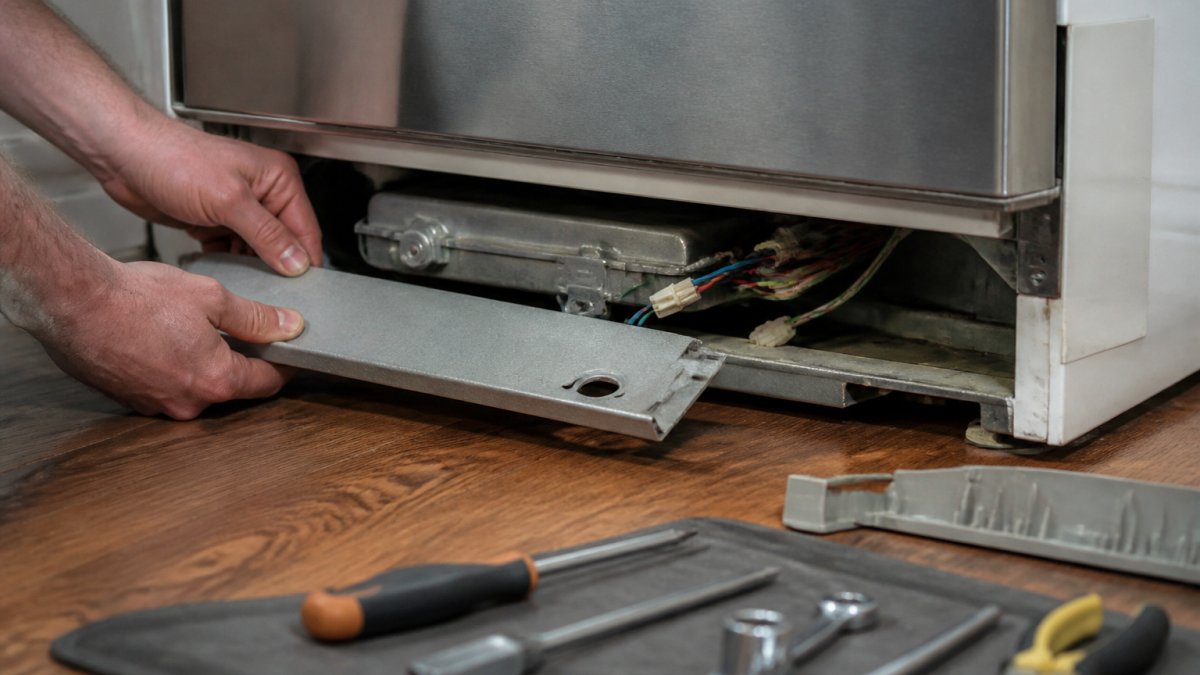
Locating the heating element and access panel
Most heating elements sit at the bottom of the tub. Access them by removing the lower spray arm and access panel beneath it.
Some models have the element mounted on the side of the tub or feature an inline heater assembly. Check your documentation before starting.

Remove the lower rack first. Unscrew the spray arm by turning it counterclockwise. Most panels are held by 2-4 screws.
Removing the old element and disconnecting wires
Once the access panel is open, you'll see the heating element and wire connectors. Most elements are held by retaining nuts or clamps.
Photograph the wire connections before disconnecting anything. Take a clear picture of which wires attach to which terminals. This prevents confusion during reinstallation.
Loosen the retaining nuts holding the element in place. Some models use spring clamps instead.
Installing the replacement heating element
Before installing your new element, verify it matches your model number. Our Vulcan Dishlex Supreme heating element (Part # C059008X) fits many common Australian dishwashers and costs $88.54.
Insert the new element into its mounting location, aligning terminals with wire connectors. It should fit smoothly without forcing.
Secure the element using the original retaining nuts or clamps. Tighten firmly but do not over-tighten, as this cracks ceramic insulators.
Reconnecting wires and securing the element
Reconnect wire terminals to the new element, matching your photograph. Push connectors firmly until they click into place.
Vulcan Dishlex Supreme, Global Stainless Steel Heating Element - Part # C059008X →
Reinstall the access panel and spray arm. Replace the lower rack.
Restore power to your dishwasher. Run a short test cycle without dishes to verify the element heats properly before washing your next load.
Dishwasher Not Heating Up: Troubleshooting Beyond the Element
Check your circuit breaker first. If it trips again immediately after reset, stop and call a technician.
Thermal fuses protect dishwashers from overheating. A blown thermal fuse cuts power permanently and must be replaced if faulty.
Control boards regulate heating cycles. A defective board may prevent the element from receiving power even if the element works correctly.
Water inlet valves control water temperature during the wash cycle.
Dishwasher Heating Element Replacement Cost and Part Selection
Replacement heating elements range from $70 to $150 depending on your model and whether you choose OEM (original equipment manufacturer) or aftermarket parts.
Finding your dishwasher model number
The model number is printed on a label inside your dishwasher, typically along the top edge of the tub frame or side walls near the spray arm.
If you cannot find the label inside the tub, check the back of the dishwasher, installation manual, or the manufacturer's website.
Once you have the model number, search online for "[your model number] heating element" or contact the manufacturer's parts department.
OEM versus aftermarket heating elements
OEM (original equipment manufacturer) parts are made by the dishwasher's original manufacturer or authorised supplier. They guarantee compatibility and typically carry a 12-month warranty.
Aftermarket parts are made by third-party manufacturers and cost $70-$100. They fit most common models but may have shorter lifespans.
For most households, the cost difference ($20-$50) is worth paying for an OEM element.
Verifying part compatibility before purchase
Before ordering, confirm three things:
-
Model number match: The part listing must explicitly state your dishwasher's model number. Do not assume a part will fit based on brand alone, Fisher & Paykel, Dishlex, Electrolux, and other brands manufacture dozens of models with different element designs.
-
Wattage and voltage: Australian dishwashers typically use 240-volt elements rated between 2,500 and 6,000 watts. The replacement element must match your original element's wattage. Check your service manual or the original element's label for the wattage rating.
-
Terminal type and mounting: Verify that the replacement element uses the same connection and mounting style as your original.
Many online retailers allow you to enter your model number and automatically show compatible parts.
Typical costs for common models
Heating-element prices vary by model and supplier. As a general guide:
- Fisher & Paykel models (DX, DD, or DW series): $80-$130 for OEM elements
- Dishlex models (DX or Supreme series): $85-$125 for OEM elements
- Electrolux and AEG models: $90-$140 for OEM elements
- Generic or universal aftermarket elements: $60-$90
Labour costs for professional replacement typically range from $200-$400. DIY replacement saves this cost but requires confidence working with electrical components.
Where to source replacement elements
Reputable suppliers include manufacturer parts departments, authorised service agents, online parts retailers (verify model compatibility and return policy), and electrical wholesalers.
Always purchase from a supplier that allows returns or offers a warranty. If a part arrives and doesn't fit, you need the option to exchange it without penalty.
Post-Repair Testing and Common Mistakes to Avoid
After replacing your heating element, run a short wash cycle without dishes.
Listen for unusual noises. Crackling, buzzing, or popping indicates a problem.
If your dishwasher still won't heat after replacement, the problem likely lies with the control board, thermal fuse, or inlet valve.
Whether you choose to replace the heating element yourself or hire a technician, having the right part on hand speeds up the repair.
Frequently Asked Questions
How do I know if my dishwasher heating element is faulty?
Common signs include dishes that remain cold or wet after a cycle, the dishwasher running normally but not heating water, or the machine tripping your circuit breaker repeatedly. You can confirm a faulty heating element by testing continuity with a multimeter, a reading of infinity (no continuity) indicates failure. If the element shows continuity but your dishes still aren't heating, the issue may lie elsewhere in the heating circuit or power supply.
How much does it cost to replace a dishwasher heating element?
Replacement heating elements range from $70 to $145 depending on your dishwasher model. For example, the Fisher & Paykel DWE900 inline heater assembly costs $70.09, while the Vulcan Dishlex Supreme element (Part C059008X) is $88.54. The Dishlex DX series inline heater runs $113.14, and the Fisher & Paykel Dishdrawer DD60 heater with seals is $144.41. These prices are significantly lower than replacing the entire appliance, making repair a cost-effective choice for most households.
How long does it take to replace a dishwasher heating element?
Most homeowners can complete the replacement in 1-2 hours, depending on accessibility and your comfort with electrical work. Inline heater elements (hidden inside the dishwasher's plumbing) typically take longer to access than bottom-mounted elements. First-time repairs may take closer to 2-3 hours. If you're unfamiliar with electrical work or your model requires significant disassembly, it's worth consulting the service manual or seeking professional help.
What should I check before ordering a replacement heating element?
Always verify your dishwasher's model number, found on the manufacturer's label inside the door edge or on the back panel. Cross-reference this against the compatible models listed for your replacement part. Different brands (Dishlex, Fisher & Paykel, Smeg, etc.) and series use different heating elements, so ordering the wrong part wastes time and money. If you're unsure, contact the supplier with your model number to confirm compatibility before purchasing.
Share this post
- 0 comment
- Tags: dishwasher heating element replacement cost, dishwasher heating element symptoms, dishwasher not heating up, how to replace dishwasher heating element, how to test a dishwasher heating element, replace dishwasher heating element
0 comment