
Is It Worth Repairing a 10 Year Old Fridge? Honest Verdict
Posted by Editorial Team on
Table of Contents
- The Verdict: When Repairing a 10 Year Old Fridge Makes Sense
- 10-Year-Old Fridge Repair Cost: What You'll Actually Pay
- How Long Does a Fridge Last, and Is 10 Years a Good Run?
- Common Refrigerator Problems and Repairs: Which Faults Are Worth Fixing
- Signs a Fridge Needs Replacing (Not Just a New Part)
- Energy Costs and Payback: Does an Older Fridge Cost More to Run?
- Food Safety, Refrigerant and Disposal: What to Do During a Breakdown
- Conclusion: Making the Call on Your Fridge
- Frequently Asked Questions
Last Updated: October 17, 2026
The Verdict: When Repairing a 10 Year Old Fridge Makes Sense
The short answer: repairing a 10 year old fridge is worth it when the fault is minor, parts are available, and the bill stays well below half the cost of a new unit. A noisy fan motor or failed thermostat is a cheap fix; a failed sealed system on a rusting unit is money down the drain.

At Allfix Electrical, we've supplied appliance parts to the trade and public for more than 45 years, so we've watched thousands of these decisions play out. Most 10-year-old fridges that get scrapped didn't fail because of age alone, they failed because the repair quote was close to the price of a new one.
That's the whole game: comparing repair cost against replacement cost, honestly.
The 50 Percent Rule, Applied Honestly
The 50 percent rule is a common benchmark: if a repair costs more than half the price of a comparable new fridge, replace it. It's a reasonable starting point, not a law of physics.
Factor |
Favours Repair |
Favours Replace |
|---|---|---|
Repair cost vs new unit |
Under half the purchase price |
Over half the purchase price |
Appliance age |
8-10 years, otherwise sound |
12+ years, multiple past repairs |
Fault type |
Fan, thermostat, gasket, relay |
Compressor, sealed system |
Parts availability |
Readily available |
Discontinued |
Energy use |
Runs efficiently |
Running costs climbing |
Apply the rule with judgment. A repair at 45 percent of replacement cost on a fridge that's already had two repairs this year is still poor value.
10-Year-Old Fridge Repair Cost: What You'll Actually Pay
We won't quote a firm repair estimate, it depends on the fault, model and technician. What we can show is how repair costs break down in practice.
A service call covers travel and diagnosis; labour is hourly or a fixed job rate; parts are the variable. A thermostat or fan motor is inexpensive, a compressor or control board is not.

The parts themselves are often the cheapest part of the job.
Itemised Comparison: Repair vs Replace a 10-Year-Old Fridge
Here's the comparison most guides skip: the numbers for a 10-year-old fridge with a thermostat fault, using realistic ranges. Figures are indicative, your quote will vary, but the structure is what matters.
Cost Item |
Repair Path |
Replace Path |
|---|---|---|
Diagnostic/service call |
$80 - $150 (often waived if you proceed with the repair) |
Not applicable |
Replacement part |
$37.50 - $126.34 (typical thermostat or fan motor) |
Included |
Labour |
$180 - $240 per hour, or a fixed job rate of $140 - $200 for a straightforward swap |
Not applicable |
New appliance purchase |
$0 |
$700 - $2,500 for a comparable capacity and configuration |
Delivery |
$0 |
$50 - $120 |
Installation and levelling |
$0 |
$0 - $150 (often bundled with delivery) |
Old unit disposal |
$0 |
$30 - $90, or free via some council services |
Expected remaining life |
Several more years if otherwise sound |
Full new lifespan (10 - 15 years) |
Indicative total |
$200 - $650 |
$780 - $2,860 |
The repair path wins clearly when the part is inexpensive and the fridge is otherwise healthy. It loses when the fault sits in the sealed system or the compressor, because those jobs push labour and parts into four figures and the total climbs toward the replacement column.
Where the Hidden Costs Sit
Three costs catch people out. The diagnostic fee is sometimes charged separately, so a "$140 call-out" becomes $140 plus the repair, ask if it's credited against the job. At Allfix Electrical any callout &/or diagnostic fee is charge only once and is part of the overall job cost if parts & additional labour is required.
Add those three together and the true gap between repairing and replacing narrows by $200 - $350. That is often the difference between a repair that looks marginal on the headline part price and one that is clearly the better financial call.
How Long Does a Fridge Last, and Is 10 Years a Good Run?
A well-maintained fridge commonly lasts 10 to 15 years, though many run longer. Ten years is a solid innings, not a death sentence.
What shortens a fridge's life? Poor ventilation around the condenser coils, a door gasket that never seals properly, and dust build-up that forces the compressor to work harder.
If your fridge is 10 years old and this is its first real fault, it's still in the healthy part of its lifespan.
Common Refrigerator Problems and Repairs: Which Faults Are Worth Fixing
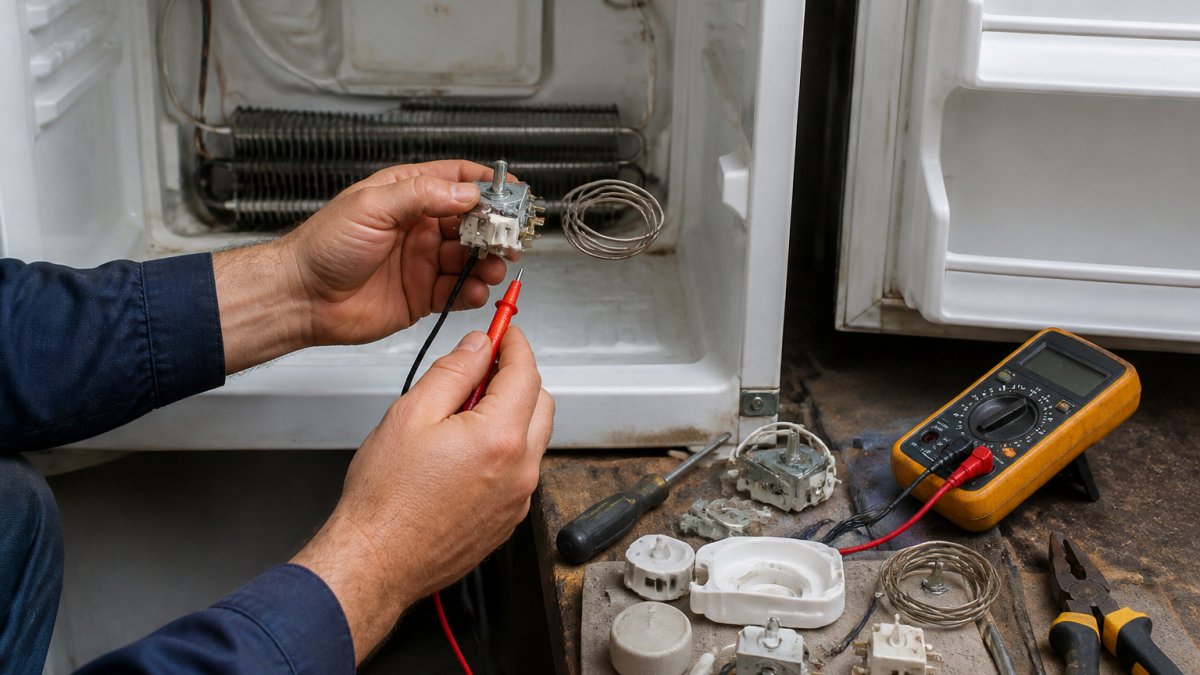
Most fridge faults are either cheap and fixable or expensive and borderline. Knowing which before the technician arrives puts you in control. The table below separates them by symptom, mechanism and cost band.
Genuine Westinghouse No Frost Fridge Thermostat - Part # 1401960 →
Fault-by-Fault Decision Guide
Fault |
Typical symptoms |
What's happening |
Cost band |
Verdict on a 10-year-old fridge |
|---|---|---|---|---|
Thermostat |
Fridge runs too cold, too warm, or not at all; compressor never cycles |
The temperature sensor or its capillary tube has failed, so the compressor gets the wrong signal |
Low (part $37.50 - $121.35 plus labour) |
Repair |
Noise from the freezer, poor cooling, frost in the wrong place |
The fan that moves cold air around the compartment has seized or slowed |
Low to mid (part around $126.34 plus labour) |
Repair |
|
Condenser fan motor |
Fridge runs hot, compressor cycles more often, poor cooling in warm weather |
The fan that cools the condenser coils has failed, so heat can't be shed |
Low to mid |
Repair |
Door gasket |
Cold air escaping, condensation on the frame, rising power bills |
The seal has hardened or torn, letting warm air in |
Low (part plus fitting) |
Repair, and it pays for itself in energy savings |
Defrost timer or heater |
Frost builds up on the evaporator, fridge warms, water pooling |
The defrost cycle has stopped, so ice blocks airflow |
Mid |
Repair if the model is supported |
Start relay |
Compressor won't kick in; clicking from the back |
The relay that starts the compressor has failed |
Low (small component) |
Repair |
Control board |
Erratic behaviour, no cooling, error codes |
The main board has failed or a connection has corroded |
Mid to high, and model-dependent |
Borderline, repair only if the board is available |
Compressor |
Loud knocking, constant running, no cooling at all |
The compressor itself has failed |
High (part plus licensed labour) |
Usually replace |
Sealed system leak |
Fridge never gets properly cold, oil residue near joints |
Refrigerant has escaped and the system needs recovery, repair and recharge |
High (licensed refrigerant work) |
Usually replace |
How to Read the Table
The fault type matters more than age: a 12-year-old fridge with a failed fan motor is a better repair candidate than a 9-year-old with a failed compressor. Cost band is the first filter; parts availability the second, a mid-band fault on a discontinued board is effectively high-band, because the repair can't be completed.
A few caveats. Model variation is real: a thermostat swap is a ten-minute job on one brand and half a cabinet teardown on another, so labour can move a fault between bands.
Signs a Fridge Needs Replacing (Not Just a New Part)
Sometimes the symptoms point past repair. Watch for these signals:
- The fridge is rusting or the liner is cracked. Structural problems aren't worth chasing.
- It's had multiple major repairs in a short window. The pattern signals end of life.
- Parts are discontinued. If the manufacturer no longer supplies the component, repair isn't an option unless an aftermarket part exists.
That last point deserves its own section, because it's the one most people underestimate.
Energy Costs and Payback: Does an Older Fridge Cost More to Run?
Older fridges generally use more electricity than newer models, and the gap widens as seals wear and compressors lose efficiency. Rather than quote an unverifiable figure, here's how to calculate your own payback.
- Find your fridge's wattage on the rating plate, or use a plug-in energy meter for a week.
- Multiply the weekly figure by 52 for annual consumption.
- Multiply by your electricity tariff per kilowatt-hour.
- Compare that annual running cost against a new fridge's estimated consumption.
If the annual saving from a new unit, multiplied over the years you'd keep it, exceeds the purchase price difference, replacement wins on energy alone. If it doesn't, repair stays in front.
Food Safety, Refrigerant and Disposal: What to Do During a Breakdown
A broken fridge is a food safety problem before a financial one. Keep the door closed, a full fridge holds temperature longer than an empty one.
On refrigerant: older fridges may contain gases that must be recovered properly. Never puncture the sealed system or dump a fridge kerbside, use a licensed technician or your council's appliance disposal service.
If you're repairing rather than replacing, get the part right. Ordering the wrong thermostat or fan motor wastes time and money.
Conclusion: Making the Call on Your Fridge
The decision comes down to three questions: what's the fault, what will the repair cost relative to a new unit, and is the fridge otherwise sound? Answer honestly and the choice usually makes itself.
When repair is the right call, getting the correct part quickly is what keeps the job cheap. Allfix Electrical stocks thermostats, fan motors and components for major white goods, with fast handling and over 45 years of parts experience behind every order.
Frequently Asked Questions
Is it worth trying to fix a 10 year old refrigerator?
It depends on the fault and the quote. If the repair costs less than half the price of a comparable new fridge and the fault is a minor one, such as a thermostat, fan motor, door gasket or water valve, repairing a 10 year old fridge usually makes sense. Sealed system faults like a failed compressor or refrigerant leak are the exception: they are labour-heavy and often push the bill past the point where replacement wins.
How much should you spend repairing a 10-year-old fridge?
A common benchmark is the 50 percent rule: keep the repair bill under half the cost of a new fridge of similar size. If a comparable replacement is around $1,200, a repair quote above roughly $600 deserves scrutiny. Get an itemised quote covering the service call, labour and replacement parts, then compare it against the purchase price, delivery, installation and disposal costs of a new unit before committing.
Does an older fridge use more electricity than a new one?
Often, yes. Older fridges generally run less efficiently than newer models, and worn door seals or a tired compressor make it worse. Check the energy rating label on your fridge and compare it with a current model of the same size. If the annual running cost difference is large, add a few years of that gap to the repair bill; it can tip a borderline repair decision toward replacement.
Which fridge problems are worth repairing?
Minor faults with affordable, available parts are usually worth fixing: a faulty thermostat, a noisy or failed evaporator fan motor, a torn door gasket, a blocked defrost drain or a failed water valve. These are common refrigerator problems and repairs that a technician can diagnose and fix without touching the sealed system. Compressor failures, refrigerant leaks and control board faults on an old unit are the ones to weigh carefully against replacement.
Should you repair a 12 year old refrigerator?
At 12 years, a fridge is past its typical service life, so the bar for repair gets higher. A cheap fix on an otherwise healthy unit can still be worthwhile, especially if parts are readily available. But if the quote is significant, or the fault is in the sealed system, replacement is usually the better long-term value. Weigh the repair estimate against replacement cost and expected remaining life, not just the sticker price.
Share this post
- 0 comment
- Tags: 10-year-old fridge repair cost, common refrigerator problems and repairs, how long does a fridge last, is it worth repairing a 10 year old fridge, repairing a 10 year old fridge, signs a fridge needs replacing
0 comment