
Why Is My Oven Not Heating Up? 7 Steps to Diagnose
Posted by Editorial Team on
Last Updated: October 23, 2026
Quick Summary
An oven not heating is usually caused by a tripped breaker, a wrong function setting, a failed heating element, or a faulty thermostat or sensor. Check the power supply and settings first, then test the element with a multimeter before replacing parts. Gas ovens need a licensed technician.
- Switch the oven off at the wall and let it cool before inspecting or testing any component.
- A well-behaved oven holds within roughly 10-15°C of the set temperature once stabilised.
- A failed element shows no reading on a multimeter set to resistance, meaning it needs replacing.
- If the fan runs but the oven stays cold, the fan oven element is the likely culprit.
- Repair usually wins if the oven is under 10 years old and otherwise in good condition.
Table of Contents
- Why Your Oven Is Not Heating Up: Start With the Simple Checks
- Oven Not Getting Hot Enough: Temperature and Thermostat Faults
- Oven Heating Element Not Working: How to Spot a Failed Element
- How to Test an Oven Element Safely With a Multimeter
- Oven Not Heating But Grill Works: What That Tells You
- Gas Oven Not Heating: Igniter and Safety Valve Checks
- Repair or Replace? Costs, Timing and When to Call a Technician
- Frequently Asked Questions
Why Your Oven Is Not Heating Up: Start With the Simple Checks
An oven that will not heat is one of the most common appliance faults, and the cause is often simpler than homeowners expect. Before you price a new element or call a technician, rule out the basics.
Below, we walk through a safe, step-by-step diagnosis. You will learn what to check, how to test parts, and when to stop and call a repair technician.
Check the Power Supply and Fuse Box First
Start at the fuse box. A dedicated oven circuit often has its own fuse or breaker, and a tripped breaker will cut all heat while leaving the clock or display working.
- Look for a tripped switch or a blown fuse on the oven's circuit.
- Reset the breaker once. If it trips again, stop and call a technician.
- Confirm the wall switch beside the oven is on, if you have one.
A power supply fault is the cheapest fix on this list. Check it before anything else.
Confirm the Oven Function and Settings
A surprising number of "faulty" ovens are set to the wrong function. If the fan runs but there is no heat, the dial may be on defrost or fan-only mode.
- Check the oven function dial is on Bake, Fan Bake, or Grill, not Defrost.
- Confirm the temperature dial is turned up, not left at zero.
- Check the timer is not set to "auto" or delayed start, which can hold the oven off.
If the display shows a lock or auto icon, reset the timer and try again.
Oven Not Getting Hot Enough: Temperature and Thermostat Faults
When an oven not getting hot enough is the complaint, the thermostat or temperature sensor is the usual suspect. These parts tell the oven when to switch the element on and off. If they drift, the oven heats weakly or overshoots.
It helps to understand the two parts, because they fail differently:
- Thermostat (mechanical ovens): a capillary tube and bulb sense cavity temperature and open or close a contact. Over time the contacts pit or the calibration drifts, so the oven cuts out early or late.
- Temperature sensor / probe (electronic ovens): a resistance element (often a thermistor) feeds a reading to the control board. A failing sensor sends a wrong reading, so the board switches the element on for too long or not long enough.
Signs of a thermostat or sensor fault include:
- The oven takes far longer to preheat than it used to.
- Baked goods brown unevenly or come out pale.
- The set temperature and the real temperature do not match.
Check the Real Temperature Before You Replace Anything
Do not assume the thermostat is faulty because a cake sank. Confirm the oven is actually running cold with an oven thermometer:
- Put a standalone oven thermometer on the middle shelf.
- Set the oven to 180°C on Fan Bake and let it run for 20 minutes.
- Note the reading every 10 minutes for half an hour.
A well-behaved oven holds within roughly 10-15°C of the set temperature once it has stabilised. A consistent gap of 20°C or more in one direction points to calibration drift or a failing sensor rather than a heating element.
Recalibrate Before You Replace
Many electronic ovens let you adjust the temperature offset in the settings menu, often labelled 'oven calibration', 'temperature adjust' or similar. The manual will show the steps, and the adjustment is usually a few degrees either way. Recalibrate first, retest with the thermometer, and only then suspect the part. Mechanical thermostats can sometimes be adjusted via a calibration screw on the shaft, but this is fiddly and easy to get wrong; if you are unsure, have a technician do it.
Test the Sensor or Thermostat
If calibration does not fix it, test the part:
- Thermistor sensor: isolate the power, disconnect the sensor, and measure resistance across its terminals with a multimeter. Compare the reading to the model's resistance chart (usually in the service manual) at room temperature. A reading far outside the expected range, or an open circuit, means the sensor has failed.
- Mechanical thermostat: continuity across the contacts should change as the bulb warms and cools. No change means the thermostat is stuck.
If the oven still will not hold temperature after calibration and testing, the thermostat or sensor likely needs replacing. We stock a Chef 70deg-290deg oven thermostat for many late-model Chef ovens if you have confirmed the fault.

Oven Heating Element Not Working: How to Spot a Failed Element
A failed oven heating element is the single most common reason an oven stops heating. Elements burn out over time, and the break is often visible.
Look for these signs of an oven heating element not working:
- A visible blister, crack, or split in the element.
- The element stays cold while the oven runs.
- The oven heats on one function but not another.
Bake Element vs Fan Oven Element
Most ovens have two heating elements. Knowing which one has failed tells you what to replace.
- Bake element: sits at the bottom of the oven cavity and provides base heat.
- Fan oven element: sits at the back behind the fan and heats air that the fan circulates.
If the fan runs but the oven stays cold, the fan oven element is the likely culprit. If the base of the oven stays cold but the top works, suspect the bake element.
How to Test an Oven Element Safely With a Multimeter
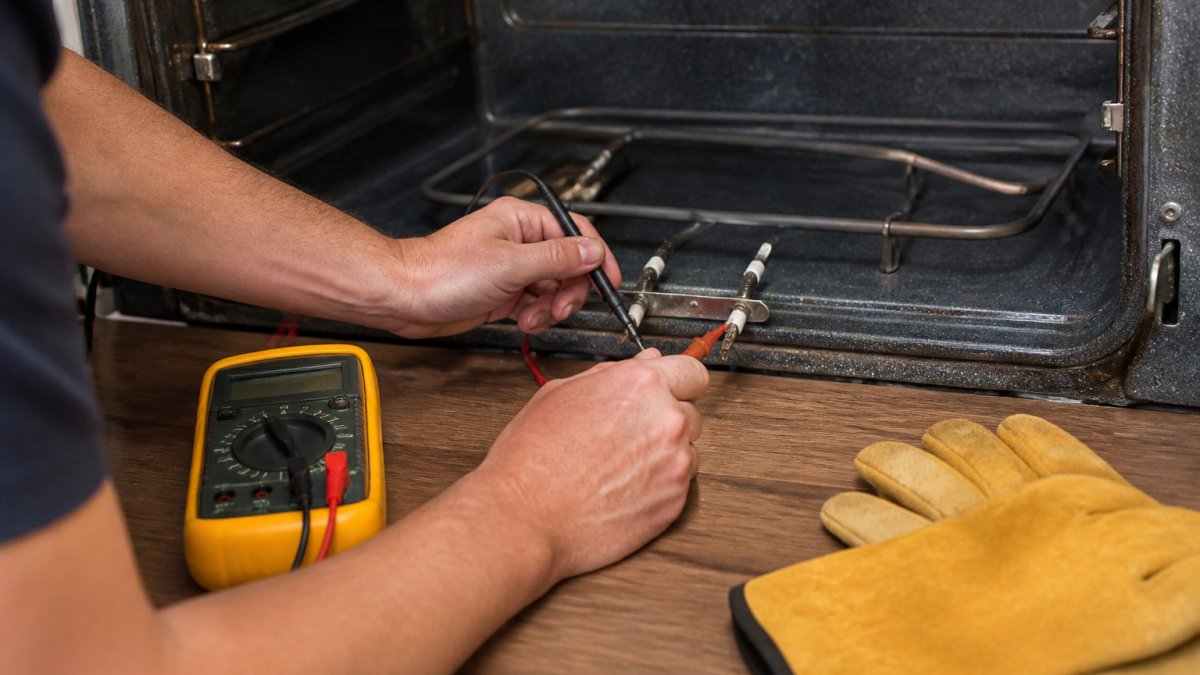
Testing an element takes about ten minutes and confirms whether it has failed before you spend money on parts. You need a multimeter set to resistance (ohms).
Total time: 15 minutes Difficulty: Beginner to intermediate
Omega, Blanco, Everdure 2000 Watt Fan Forced Oven Element - Part # SE318 →
What you'll need:
- A multimeter
- A screwdriver to access the element terminals
- Safety gloves
Step 1: Isolate the power. Switch the oven off at the wall and pull the fuse or trip the breaker.
Step 2: Access the terminals. Remove the element's cover panel to reach the spade terminals.
Step 3: Test for continuity. Touch one probe to each terminal. A working element shows a resistance reading.
Expected result: A reading means the element is intact. No reading means it has failed and needs replacing.
If you are unsure how to test an oven element, a technician can confirm it in minutes. If you have the reading and know the part, we carry fan oven elements such as the Omega, Blanco and Everdure 2000W fan forced element and the Westinghouse 2200W fan forced element.


Oven Not Heating But Grill Works: What That Tells You
When the oven not heating but grill works, the fault is almost always in the bake or fan circuit, not the power supply. The grill element runs on its own circuit, so a working grill proves the oven has power.
This narrows the fault to:
- A failed bake or fan oven element.
- A faulty thermostat or function switch.
- A control board fault affecting only the bake circuit.
Start by testing the bake element as above. If it tests fine, the function switch or control board is the next suspect.
Gas Oven Not Heating: Igniter and Safety Valve Checks
A gas oven that will not heat usually has a faulty igniter or a safety valve that will not open. The igniter glows to light the gas, and the safety valve only opens once the igniter draws enough current.
Watch for these signs:
- The igniter glows but the gas does not light.
- You smell gas but see no flame.
- The oven clicks but stays cold.
Gas appliance repairs must be done by a licensed technician in line with local gas safety rules (Gasfitters). Do not attempt to replace a gas igniter or safety valve yourself.
Repair or Replace? Costs, Timing and When to Call a Technician
Most oven heating faults are worth repairing, especially when the fix is a single element. A failed element or thermostat is a quick swap once you have the right part. The decision comes down to three things: the part cost, the labour, and the age and condition of the oven.
What Repairs Typically Involve
- Element replacement: usually the cheapest and fastest fix. A bake or fan element is often a 15-30 minute job once the power is isolated and the panel is off. The part is the main cost.
- Thermostat or sensor replacement: a little more involved because the sensor or capillary has to be routed, but still a straightforward job on most models.
- Control board or wiring faults: the most expensive category. Boards are costly, diagnosis takes longer, and on an older oven the repair can approach the value of the appliance.
A Simple Repair-or-Replace Framework
Ask these questions in order:
- Is the fault a single, known part? If yes, element, thermostat, sensor, repair is almost always the right call.
- Is the oven under 10 years old and otherwise in good condition? Repair usually wins.
- Is the repair cost more than roughly half the price of a comparable new oven? Replacement starts to make sense, particularly if the oven is old, the door seal is worn, or the enamel is damaged.
- Is the fault intermittent or returning after reset? That points to a board or wiring issue, which is where replacement often becomes the better value.
When to Call a Technician
Call a technician when:
- The control board or wiring is faulty.
- You smell gas or see damaged wiring.
- The fault returns after a reset.
Timing and Parts Availability
Repair time depends mostly on whether the part is in stock. A common element or thermostat can often be fitted the same day or next day; a control board for an older or less common model can take longer to source.
We keep many oven elements and thermostats in stock and dispatch fast, so you are not waiting weeks for a part.
Frequently Asked Questions
Why is my oven not heating but the grill works?
If the grill works but the oven does not heat, the fault is usually in the bake or fan oven element, not the power supply. The grill uses a separate element, so a working grill confirms the oven has power. Test the bake element for continuity with a multimeter; a reading of infinite resistance means the element has failed and needs replacing. Thermostat or control board faults can also cause this pattern, so check the element first before calling a technician.
How can I tell if my oven heating element is not working?
A failed oven heating element often shows visible signs: blistering, cracks, or a broken coil. If the element looks intact, test it with a multimeter set to resistance. Disconnect the oven from power, remove the element, and measure across its terminals. A good element shows a resistance reading; no reading means it is open circuit and must be replaced. Allfix Electrical stocks fan oven elements such as the Omega, Blanco, Everdure 2000W element (Part SE318) for $79.16.
Can I replace an oven heating element myself?
Yes, replacing an oven element is a common DIY repair if you are comfortable working with basic tools. Always switch off the oven at the isolator and the fuse box first. Remove the back panel inside the oven, disconnect the spade terminals, and unscrew the old element. Fit the new element in reverse order, making sure the terminals are tight. If you are unsure which part fits your model, contact Allfix Electrical with your full model number before ordering.
When should I call an appliance repair technician about an oven that will not heat?
Call a technician if you have checked the power supply, confirmed the settings, and tested the element but the oven still does not heat. Faults in the thermostat, control board, or gas igniter require specialist tools and, for gas appliances, a licensed technician. Also call a professional if the oven trips the safety switch, smells like gas, or shows error codes you cannot clear. Allfix Electrical offers technical assistance to help you decide whether a repair is worth it.
A cold oven rarely means a new appliance. Most faults trace back to a tripped breaker, a wrong setting, or a failed element you can test and replace yourself. When you need the correct part quickly, Allfix Electrical stocks oven elements, thermostats, and sensors, backed by over 40 years of experience and fast dispatch. Search our range with your model number and get your oven heating again.

Share this post
- 0 comment
- Tags: how to test an oven element, oven heating element not working, oven not getting hot enough, oven not heating, oven not heating but grill works, why is my oven not heating up
0 comment